Showing posts with label family stories Ben. Show all posts

Friday, October 18, 2013

how we're going

Well, the chronic pain team at the hospital has graduated Ben from their program. I feel in equal parts abandoned and relieved.

Abandoned, because Ben still has a chronic pain condition, and we're on our own now. (We're not, of course. But that's how it feels.)

Relieved, because they obviously think we're on the right track, and we no longer have to do three hour round trips through heavy traffic.
And yes, Ben is making steady progress:
  • our family is going out soon to celebrate that he was at school for at least a couple of hours nearly every day last term, headache and all
  • we were expecting his energy levels to deteriorate by the end of term, but he was actually getting a little better, which suggests this approach is working
  • he recently enjoyed a full day's party with four friends; three months ago he could barely manage two hours with one friend
  • he also did an intense bushwalk; three months ago he could only do 30 minute's flat walk.
On the other hand, Ben only managed two full days last term, and they didn't go brilliantly. We're aiming for two full days a week this term, but we haven't made it yet. Meanwhile, there are lots of school drop-offs and pick-ups and interrupted days. It's never easy to take a child to school when he's in pain.

So it's over to us. Perseverance, daily exercise, perseverance, getting enough sleep, perseverance ... we - or, rather, Ben - have to keep working away at this thing until he is well.

Which he will be. In time. Humanly speaking, and God willing. For most children with this condition, the journey out is as long as the journey in (and that was several years).

If I forget how far we've come, I only have to think back to the bewilderment and desperation of four months ago. These days, I don't burst into tears when I'm in a safe environment and people ask me how I am (though I'm not promising anything). I'm no longer battling high levels of anxiety and panic.

Ben's pain no longer feels like "my issue", something I'm suffering as much as him. This is good for both of us. It means he doesn't bear the burden of my sorrow as well as his own. It means I can see things clearly and support him well. It means he learns, as he must, to manage his health independently.
And what has this all done for Ben? Only God knows. But I've watched him grow in resilience and patience. I've seen his self-awareness and wisdom increase. I've helped him dig deep into the Bible's teaching on suffering, and take from it God's comfort and strength.

He's as tall as me now, thirteen years old, and his voice is as deep as his father's. The outer, visible changes mirror the ones within.

Tuesday, July 23, 2013

CS Lewis on how to read books from a different time

Ben's English teacher (or, as a French textbook might have it, The English Teacher Of My Son Ben) has encouraged him to read some books from Ye Olde England. Guess I'll be reading along.

My mouth is watering. I finally get to fill in some of the yawning gaps in my education!

When you do science all the way through school, and only come to Arts several years later (after an abortive attempt at Medicine), and then choose to study lots of modern literature (what was I thinking?!) ... well, let's just say that I've got a lot of catching up to do.

On the list are The Anglo-Saxon Chronicle and Beowulf (translated from Old English) and Thomas Malory's Le Morte d'Arthur (Middle English). Also Chaucer's The Canterbury Tales, although I'll check the content first.
 
But how do you read books from such different times to our own? CS Lewis told his friend Arthur Greeves, who was obviously struggling with Beowulf and Malory,
Remember that nearly all your reading is confined to about 150 years of one particular country: this is no disgrace to you, most people's circle is far smaller. But still, compared with the world this one little period of English is very small and tho' you (and I of course) are so accustomed to the particular kinds of art we find inside it, yet we must remember that there are an infinite variety outside it, quite as good in different ways.

And so, if you suddenly go back to an Anglo-Saxon gleeman's lay, you come up against something absolutely different - a different world. If you are to enjoy it, you must forget your previous ideas of what a book should be and try and put yourself back in the position of the people for whom it was first made.

When I was reading it I tried to imagine myself as an old Saxon thane sitting in my hall of a winter’s night, with the wolves & storm outside and the old fellow singing his story. In this way you get the atmosphere of terror that runs through it—the horror of the old barbarous days when the land was all forests and when you though that a demon might come to your house any night & carry you off.

The description of Grendel stalking up from his ‘fen and fastness’ thrilled me. Besides, I loved the simplicity of the old life it represents: it comes as a relief to get away from all complications about characters & ‘problems’ to a time when hunting, fighting, eating, drinking & loving were all a man had to think of it.
(Letters, 143; Nov 1st, 1916).

Monday, May 20, 2013

rules to live by

There is a boy. He sits in a room, surrounded by adults, in a circle of adults. He speaks calm words about himself, about the last three years of his life, about this thing they call chronic daily headaches, about the pain and its beats and measures. He is not calm, but you wouldn't know it. She knows, because later he tells her.

There is a woman, his mother. She is silent, allowing him to speak. She shifts in her chair, and her jeans make an embarrassing noise on the vinyl. She hopes no one heard. She knows they probably did, this room full of attentive adults. She crosses her legs. She crosses them the other way. She listens. She waits her turn.

There are six other adults in the room, four women, two men, members of the chronic pain management team. Twelve eyes to look at the boy and his mother, twelve eyes and three hours of questions. Six different breeds of medical professional: male, female, old, young, serious, kind. They are all kind, so kind. She feels pinned by their gaze.

They ask the boy questions about the pain, how often, since when, what sets it off, what helps, where it is, how it feels. Mostly he can answer them (he's heard them before). Sometimes he can't. The questions have beaten him into silence, too many questions. How can he quantify the pain? How can he put a number to it? What if he is wrong? He has started to ask himself, what if he is a coward, when others experience far worse pain than this?

The boy wears soft grey pants and a grey jumper with a fur-lined hood. The soft edges protect him from the hard edges of their questions. As they walk to the meeting, he pulls the hood up, but his mother pulls it down. He runs his hand through his hair, and she smooths it down.

They notice this. They notice everything. They ask if he likes soft clothes. He does. His mother listens, fascinated, but she wonders what this has to do with anything. She wonders what anything has to do with anything. What are they observing about him, about her? What connections are they drawing? What are they thinking? Why won't they tell her?

They take him from the room. Two adults gone, four left plus her. They question her. They ask about his developmental milestones, relationships, intelligence, family history. Some answers she knows (she's familiar with this line of questioning). Some answers she can't remember (she should have brought his baby book). She asks herself, Why can't I remember? Why don't I know? Does it matter that I don't know?

More questions. What are his thought processes like? Positive or negative? You say positive? But what about these times? What about those? She knows, she doesn't know. She says to ask him.

He returns to the room. They ask him. He answers, or tries to answer. She marvels at the delicate balance of mind and body, so finely tuned, so easily knocked awry. Has she done this? Did they do something wrong, or not do something right? This beautiful, strong, loving boy. What have they done?

The boy and his mother are sent away for fifteen minutes, fifteen minutes of buying him a sausage roll, sitting in the sun, exclaiming at the spinning doors, wondering what conversations are happening in their absence. They return.

And they are told that they are doing okay. They are doing the right things. The doctors they are already seeing - those doctors with all their questions - are doing the right things. Maybe they could change his medication. They should probably bring him back for some physiotherapy. Oh, and there's a pain clinic he could attend. And some more questionnaires to fill in. And the occupational therapist would like to see him. The boy's mother adds the appointments to a diary full of doctors' visits. But, they say, you are doing well. We approve.

She feels relieved. The boy smiles, shifts in his chair. And it's all okay. And none of it is okay.

There is an art to this, an art she has not yet learned. To allow their lives to be examined, probed, dissected, cut open like a rat on the table. To remain undefensive, receptive. To be grateful, to listen and absorb. To know this matters immensely, could mean the difference between health and sickness. To know this doesn't always matter, the doctors don't always know, don't always agree, aren't always right.

To try things, all the time not knowing. To work away at the pain, increment by imperceptible increment, week by week. To make mistakes and pay the price of days of illness and, next week, try something new and lose more days and try again, each time one step closer. To watch her son suffer, watch him make progress, so much progress, but still so slow, so far to go.

To follow the rules, all the times ignoring the rules. To answer the questions but not allow them to strip her bare. To hear conflicting advice and know when to listen and when to ignore. To be full of needs, but not to be needy. To ask for help, yet go home and cope on their own. To do all this and not be swallowed up by it.

To get on with life. To love her son. To find the energy, somehow, to love her other three children. To be tired but not to lose her temper. To lose her temper, ask forgiveness, and not wallow but go on. To turn from tears to laughter, to learn the art of turning from tears to laughter. To be worn out, to be worn down, but to go on.

She has always been a rule-follower. She feels secure when she obeys. She needs to get it right, to get everything right. She needs to please. She is learning that this is not possible, that she can't do everything they say. That she can't do everything. That sometimes - often! - she won't know the best thing to do. That all she can do is what is best for her son, for her family, and love, and serve, and try, and love. She is learning that there is only One she lives to please, and she is already whole and loved in him.

She doesn't have the strength for this, but she knows Someone who does.


I wrote this in response to Meredith's writing challenge

Thursday, March 28, 2013

an update on how we're going

So how is Ben, I hear you ask (some of you literally)? And how am I?

Well, Tuesday - two weeks ago - was a turning-point, both in what was happening inside me (more about that another day) and with Ben. I think that's why I felt ready to publish a cry of hopelessness, which waited in the wings for weeks.

At that point Ben had been sick for over a month with constant headaches (it's not the first time: last year, he missed both a term and a month of school). Some days it was a migraine, so severe that he could only lie in a darkened room; other days, a headache far worse than what you or I might call a "bad headache". He stayed home from school and bore it with silent resignation.

Not easy to watch when you're a mother.

Every night I'd lie awake and pray, over and over, "Please heal him, Lord. Please let him be better in the morning." Every morning I'd wake up and think, "Maybe this morning he'll be better" - then I'd look in his eyes and see the shadow of a headache. Every day I'd sink a little deeper into discouragement.

Until that Tuesday, when he woke with a worse migraine than usual, and I rang his paediatrician and said, in essence, "We've had enough. Do something!" And she sent us to the hospital and all my Facebook friends prayed and we found ourselves in the emergency department (that's it in the picture above). And I sat in a chair in a little room and watched a drip running into Ben's arm and enjoyed the silence (rest! peace! It's a little sad, but I have a soft spot for hospitals).

While we were there, Ben was interrogated and examined by no less than 3 doctors. We saw one of the top paediatric neurologists - something that wasn't supposed to happen, Ben's chart didn't ask for it, but someone (providentially!) stuffed up along the line - and Ben got a new diagnosis and a new medication.

So what's his diagnosis? Chronic daily headaches (you can google it) as well as migraines.

Hearing that your child has a chronic condition isn't easy. I've shed many tears of shock and grief during the last two weeks. But it's also a relief. Why? How can it be comforting to discover your son is chronically ill?

Because we now have an explanation for why Ben's headaches haven't gone away. We know what to expect. We know what to do. I don't feel so helpless. I don't wake up every morning wondering if his headache has gone away in the night (although we will keep praying that it does) only to have my hopes dashed.

We know that progress will probably be slow. We know what Ben needs: a clear structure to his days, as much school as possible, good stress management, and daily exercise. We don't wake up wondering if he should go to school: we just help him to lead as normal a life as possible.

Every morning he gets his uniform on and I pack him into the car (no more time spent second-guessing his condition and wondering if he's well enough). Every morning my husband walks our younger boys to school (no more trying to do it all by myself). Most lunchtimes I get a call from the school asking me to pick him up, and he comes home quiet and pale.

And yes, he's in pain. And yes, it's hard for him to concentrate. And yes, he usually can't last the day. But he makes it through the first four hours of school, and he loves learning, and he has good friends and amazing teachers, and the year 7 coordinator and his mentor give him constant, attentive care. I am so thankful for these things.

Our paediatrician called us "A family in crisis", and she's right. But we're also pulling together, perhaps more than we ever have. My husband takes Ben swimming. I take him for walks. We pray and talk and, even, laugh. I'm so grateful for a husband who puts his needs aside to care for us at the end of every long day.

Now that I know what to expect, I also know what I need to get through this: the support of my family, my neighbour, my friends. Rest, exercise, an emptier timetable. Plenty of Bible and prayer. And the joy of having people like you say to me, "I'm thinking of you. How can I help? How can I pray?" That means the world to me.

Friday, February 1, 2013

starting school

Here they are, all ready to start school.

Lizzy, beginning year 9, wondering if she will make friends in her electives, looking forward to subjects like Design and Food Tech, already missing the holidays, learning what it means to be a Christian, ready to live for Jesus at school.

Ben, starting secondary school, a little apprehensive about making friends and migraines (he got one half-way through the first day of school), but "energised" (his word) by the thought of this brave new world where he gets to study science, history and geography.

Thomas, all set for grade 4, looking forward to having his best friend in his class again, constantly surprising me with his affectionate, considerate, helpful nature.

Andy, heading into grade 1, so cute with those two front teeth missing, facing school with his special brand of independence, determination, thoughtfulness, and friendliness.

I love the various stages of our children's lives. I'm enjoying (though a little exhausted by!) the in-depth 10 o'clock chats with adolescents, and the way their minds are unfolding and their faith growing. I revel in the cuddles and morning nestling of the little ones, knowing they will grow up all too soon.

We make our way through worries and tantrums and whinging and arguments. We face sickness and doubts and rebellion and repentance. We teach the Bible and try to model godliness (and often model complaining and grumpiness instead) and pray, pray, pray for our children - so many prayers!

They are growing, and they are growing well. And for that I give thanks.

Friday, November 30, 2012

Ben, migraines, and thankfulness

It's been a tough year for my 12-year-old son Ben. He suffers from migraines, and missed most of term 2 of school. During term 3 he was better than he's been for years thanks to his new medication, for which we thank God! But early this term he was sick again for a month, due to a nasty virus that stirred up his headaches. I wrote this at the end of that month.

When I think of my son this year, the words that spring to mind are "patient endurance".

I love how Ben keeps persevering and trusting in God even when he's sick. I love the way he thinks hard about his attitudes and how they affect how he's feeling. I love how he works at getting well (sleep routines, relaxation exercises, new ways of thinking, headache diaries, exercise...)

I love Ben's loyal friends and his hunger for learning, that mean he keeps up at school, even though we grieve over all he misses out on. I love that he still loves hearing God's word, even though it's often difficult for him to be at church. I love the way he soldiers through the days, and how his teachers come up to me and say, "He tries so hard!".

I love Ben's loud enthusiasm when he's well, even though it can be a little trying (as he says, he has to make the most of it!). I love the way his eyes light up when he's playing complicated games with his sister. I love his "imaginations": inventing languages, designing elaborate constructions on Minecraft, writing a novel about another world.

I love the long conversations we have on the way home from (yet another) doctor's appointment. I love our precious half-hours on the couch, when he fills me in on what he's been thinking about. I love our games and our cuddles and our love for all the same books.

I love his patience and quiet persistence. I love his compassion and helpfulness. I love his love for Jesus.

I love my Ben.

P.S. Ben has recovered from his virus and has been well for several weeks now, except for a couple of one-day migraines. Thank God with us, that well is our new normal.

Saturday, March 10, 2012

raising a hand

In one of those lovely glimpses you get into a child's character during parent-teacher interviews, Ben's teacher told me he has to work really hard during class discussions not to look at Ben - who inevitably has his hand up - while he encourages one of the other 25 kids to answer the question.

He says it reminds him of Martin in The Simpsons. It reminds me of Hermione in Harry Potter. Nerds of the world - and fellow Hermione fans - unite!

Saturday, February 25, 2012

only an N could say that...

I overheard my older son Ben saying to my middle son Thomas,

"Thinking and dreaming about something is just as good as doing it."

Only an N could say that.

Although surely there's something a little Hebrews 11:13-16 about it?

At least it will save lots of money on overseas trips.

Saturday, November 26, 2011

another volcano cake that almost worked

For some reason, it's been a year for volcano cakes in our house. Here's another volcano cake we made that almost worked - and it would have worked perfectly if I read the recipe more carefully! :) It was very easy, and the yummiest birthday cake we've ever made, by a lo-o-o-ong way. This one was for Ben's 11th birthday, and Lizzy helped me make it.

You start with a round chocolate cake (ours is a double gluten free cake from a packet)and 4 litres of ice cream softened a little (about 10 minutes) then shoved into a metal mould - this shape is great if you can get it. Put it in the freezer overnight.Turn the ice cream out on top of the cake (our ice cream is butterscotch mixed with good quality vanilla).Beat 600 ml cream with 1/4 cup cocoa and 2 tbsn icing sugar until it's thick, and spread it over the cake.Chop up lots of chocolate bars (the yummiest is Snickers, but include some Cherry Ripe, Crunchies, Toblerone and anything else you like). This is where we went wrong. I misread the recipe and bought about 400g of mixed chocolate bars instead of (believe it or not) 200g chocolate bars and 1 1/2 kg Rocky Road.Here's our volcano - as you can see, there weren't quite enough chocolate bars to cover it! But it looks good all the same. (You're supposed to pour thick strawberry topping over it, do some complicated thing with sheets of homemade toffee, and put dinosaurs and dessicated coconut mixed with green food colouring around the edge. I got a little lazy here! ;) )Put it back in the freezer to harden up for a few hours (the cream is YUMMY after you've done this). Get it out, stick some sparklers in, light them,
wait for them to go out,then watch it disappear.YUM!

This cake is adapted from the "Volcano Vibes" cake in The Australian Women's Weekly Children's Birthday Cake Book.

Saturday, May 14, 2011

family catch-up: Ben

Ben is 10 now, and shooting up fast. In many ways, he's a lot like me. He lovesscientific exploration,family,imagining (wrapped up in his favourite blanket),soft toys (he has a bedtime roster to make sure none is left out - just like me as a child),wrestling with his cousins (and anyone else who's willing),setting up elaborate scenarios for stop-gap photography,animals of any kind,and (always) reading, reading, reading.

Friday, December 17, 2010

whoopee cushion: stop motion without the motion

Ben (10) has been sick a lot this year, first with whooping cough and recently with flu. While away from school, he's done lots of stop motion photography (without the motion, because we don't have an animation program) mostly involving railway tracks and Thomas the Tank Engine.

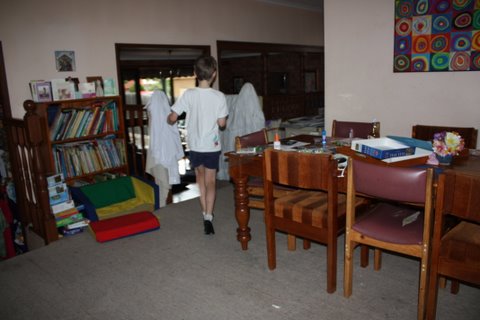
He and Lizzy made their own stop motion show (without the motion) about a whoopee cushion the other day. Here it is (without the motion - but perhaps if you squinted and scrolled down really fast...) - and, as a bonus, you get to see our messy house too! :)


Well, it made me laugh, anyway!