Showing posts with label biblical womanhood. Show all posts

Friday, May 6, 2016

book review: Word-filled Women's Ministry

Two months ago, I became the part-time women’s worker at our church. I prepared by reading Word-Filled Women’s Ministry, edited by Gloria Furman and Kathleen Nielson. I’m glad I did.

I recommend this book to anyone, male or female, involved in ministry to women. The list of the ten writers from across the globe may be enough to whet your appetite: it includes Kathleen Nielson from the US, Claire Smith from Australia and Carrie Sandom from the UK. Together, they have written a generous and gospel-hearted book that will remind you to centre your ministry on the Bible, give you a wealth of practical ideas for women’s ministry, and help you think through how to encourage women to grow and serve in your local context.

The book opens with an outstanding chapter by Kathleen Nielson about how the word of God lies at the heart of all women’s ministry. Reading this chapter reminded me of drinking in JI Packer’s Knowing God: as this is my favourite Christian book after the Bible, there is no higher praise. I finished it with tears in my eyes, thrilled again by the wonder of God’s word and determined to build every aspect of my ministry on this strong foundation. I strongly suggest you read this chapter together as a ministry team.

The second chapter is by Claire Smith. Her book God’s Good Design is a brilliant, brief and readable alternative to “The Big Blue Book” (which is what we used to call John Piper and Wayne Grudem’s Recovering Biblical Manhood and Womanhood), and this chapter packs the wealth of her knowledge and teaching on this topic into an even smaller space. If someone had questions about what the Bible says about men’s and women’s roles in the church, I’d copy this chapter and hand it to them.

The third chapter is another gem: it’s about how to train women for ministry, and it’s packed with practical ideas gained by Carrie Sandom through years of experience. For me, the highlight is her description of the year-long program she follows with women one-to-one, looking at books of the Bible that will prepare them to meet with others, thus multiplying this important ministry. It’s a plan I hope to use soon.

These three chapters make up Part 1: “The Heart of Women’s Ministry”. Part 2 is about the contexts of women’s ministry—the local church, evangelism and mission. Part 3 explores issues in women’s ministry and includes a valuable chapter on sexual wholeness and how this needs to be talked about more openly among women. The book concludes with a chapter by Nancy Guthrie on the ultimate goal of women’s ministry.

There are two more chapters I want to highlight. The first is a fascinating dialogue between an older woman (Susan Hunt) and a younger woman (Kristie Anyabwile) that puts flesh on the Titus 2:3-5 command for older women to teach younger women. What do younger women long for? What do older women have to offer? This chapter helps readers think through how to encourage cross-generational relationships and discipleship.

I also appreciated the chapter by the editors on gifts and giftedness. It’s easy, in a complementarian context, for this topic to arouse resentments: why can’t women do this or that? Why aren’t there more pathways for women? But this chapter turns these questions on their heads and asks instead how women can be equipped and encouraged to serve. It explores themes like the ways men and women can support each other in ministry, the different forms that women teaching women takes, and the many contexts open to women that are closed to men. The servant-hearted tone of the chapter—indeed, of the whole book—is summed up in this quote:
There is a place for women to serve. It will not always be the perfect place we envision. We might be called to do things we didn’t plan or want to do along the way … But we must indeed serve—with quiet, submissive, prayerful, relentless strength—because we are serving our Lord. We are serving the church he loves, for whom he died. (p. 212)
If you’re a pastor or leader of a church or ministry, a woman who ministers to women, or a woman considering pathways for service, I encourage you to read this book. In my opinion, it’s one of the best books for women that’s come out in recent years.[1] I plan to pull this book out and read it again, taking notes this time; that’s how good it is. I warmly commend it to you.

[1] Another recent book for women that I highly commend is Jen Wilkins’s Women of the Word, which I reviewed here.

This article first appeared on GoThereFor.com.

Thursday, September 11, 2014

grace-shaped womanhood: my talk on Titus 2

Well, I've done it! My very first conference talk. And I had a lot of fun too. :)

My talk was on Titus 2, and it was at our inaugural T2 Women's Conference. You can listen to it here, along with Belinda Grant's talk from Titus 3:

T2 Women.

Just click on the link under "age into a sage".

Tuesday, June 10, 2014

what I'm listening to: you can trust that man

It's one of my favourite stories about Jesus.

A woman, who's been bleeding for 12 years, touches the very edge of his cloak, and feels in her body that she's been healed.

He asks, "Who touched me?" She comes trembling, and falls at his feet.

He says, “Daughter, your faith has healed you. Go in peace.” (Luke 6:40-56)

In Annabel Nixey's talk about this woman,* she asks, do we really want this woman's faith? Or do we want something more exciting?
Jesus lifts up this woman as an example, and he says, "See her faith." ... Faith is the guts of how we relate to God. ...

The faith that this woman had in this moment, we are to have in every moment.

So what was it? It's that she had empty-handed trust, and that this trust was in Jesus.

This woman came to Jesus with nothing, and she knew it. She was no great achiever. She was a receiver.

But if I'm honest, even when it comes to God, I want to be independent. I want the glamour faith. I want the independent dependence.

There's no such thing! There is simply no such thing.

When you look at this woman trembling in front of Jesus, do you want to be like her? I'm happy to learn from her. I don't know that I want to be like her.

And yet she is the example that Jesus holds up of how to treat him. 
Me too. I'd love the glamour faith, not the broken faith. But only when I'm broken do I learn what it  means to cling to Jesus. Yet my faith is no more perfect than this woman's:
But here's the comfort. This woman is held up as an example of faith, but her faith wasn't perfect.

It was tentative at first. It was wrapped up in the superstition that she had to touch Jesus. Jesus heals her anyway.

Maybe you look at your Christian friends and family, and you longingly think, "I wish I had her faith."

Look at this woman. She didn't have some mysterious quality. She simply trusted in Jesus. 

Maybe you look inside yourself, and maybe you ask yourself, "Do I have faith? Do I have enough faith? Do I have the right kind of faith?"

It wasn't about whether she had perfect faith.

It's about who her faith was in.
Instead of examining my own faith, I am learning to look away from myself and to Jesus:
We need to lift our eyes, look to Jesus, stop the self-analysis, look at Jesus.

Do you trust that man? Because we have even more reasons to trust in Jesus than this woman did.

You can trust that man. He went on to die for his people. Right after this, he raised Jairus' daughter from the dead. Who does that? He went on to punch through death himself in the resurrection. He gave us his Spirit.

And so we know that he is going to come back, and he's going to bring a whole kingdom where there will be no more bleeding. There will be no more need for doctors. There will be no more dying.

We need to lift our eyes and look forward to that kingdom.
I've been wondering what this woman would say to us. I don't think she'd say, "Look at my faith." I do think she'd say, "Look at him!"

Look at Jesus. You can trust that man.

* This is from Annabel Nixey's talk from Equip 2013. I wrote about another talk from this conference - Anna Moss on Mary and Martha - here. I highly recommend these talks. I found them very encouraging.

Monday, April 21, 2014

what I'm reading: women, work, and the home

I couldn't wait for The measure of success to come out. Carolyn McCulley is a thoughtful, entertaining writer, and in this book she tackles the controversial topic of women, work and the home.

The first few chapters - a potted history of work - kept me glued to the page. They made me ask the question: How are our views on women, work and the home shaped by our culture as well as by the Bible? 

What did Paul mean when he encouraged young married women to "manage their households" (1 Tim 5:14) and to "work at home" (Titus 2:5)? Did he mean women with children shouldn't do paid work? Or that our homes should be beautiful? I don't think so. The reason we sometimes conclude these things is because of a post-industrial view of work and the home.

Carolyn McCulley says,
With the dozens and dozens of magazines, cable shows, and Pinterest boards, it's no surprise if you think about your home as an expression of your identity. ...

That's not the concept of the home that most people have had throughout history. The home was a center of productivity. If we don't know that history, then we will read the biblical verses about the home only through the lens of our current experience - and potentially misunderstand the intent of these passages ...

Over the last several centuries, Christians have engaged in this debate about where women should be productive. When mainstream culture devalued marriage and motherhood, Christians (and those from some other faith traditions) rightly upheld these important roles. When mainstream culture overvalued the workplace, they also rightly upheld the value of the home.

The only problem is that our modern concept of the home is not the same as the biblical concept. ... For most of human history, the home was the original small business unit, the building block of a community's economic vitality. It was only after the upheaval of the Industrial Revolution that the home moved from being a place of productivity to a place of consumption.
Did you catch that? For most of history, the home was a "place of productivity". Work was done in and from the home. Farming and manufacture were home businesses, led by mums and dads, their kids underfoot and working alongside them. Like everyone else, women worked in and from the home, in roles that earned money and roles that didn't.

What does this mean for the verses about women and work in the Bible? I'll be honest: I'm not sure. For a start, I haven't finished the book yet. But also, I don't think the answers are simple. This is going to take some time to process.

I still believe it's ideal for young kids to be cared for by a parent as much as possible. I think women will generally be the ones who do this, not just because of cultural norms, but also because that's the way God made us (Gen 2-3; Prov. 31:10-31; 1 Tim. 5:14; Tit. 2:3-5). We only see this as a problem because our society teaches us to idolize "career". Managing a home and raising kids is work, and it's meaningful, hard, skillful work.

But I am coming to see that there is flexibility and freedom in the way this might happen. It won't look the same for everyone. I have friends I greatly respect who made the decision - one that I think was wise for them - to do paid work a few days a week early in their children's lives because it helped keep them sane.* And we don't all have the choice: I have a friend who's a single mum and has to work in a thankless job so she can support her family.

I also know women who stayed home full-time with their kids until they reached school age, then took on some work outside the home; and women who stayed home with their kids, pretty much full time, into the teen years (hey, wait a minute, that's me - and my son's chronic illness has made me very grateful I have this option). Not so they can devote themselves to the "home beautiful" (an idol just as potent as "career"), but so they can love and serve those around them, and those God has entrusted to them.

Jesus doesn't want us to store up treasure on earth: sanded floorboards, a successful career, or perfectly behaved children (Matt 6:19-24). He wants us to work hard at the tasks he's given us; and he want us to work, not for ourselves, but for him (Eph 2:10; Col 3:23). He wants us to live for our true home.

You might also enjoy:

* Two had depression; one is an extrovert, with outgoing kids who enjoyed childcare, who found she was much more cheerful and productive at home while working a few days a week.


Quote is from Carolyn McCulley's The measure of success, 46-47, italics mine.

Tuesday, February 11, 2014

what I'm reading - a book for homemakers

So you're a homemaker. What book tops your homemaking list?

Or maybe you have a homemaker in your life. What book would you give them?

Until now, I didn't have a top pick. A book on biblical womanhood in the home? A book of household tips? A book on time management? They've all helped me, but more often they leave me feeling guilt-ridden and defeated.

What I really want is a book about the gospel. A book that shows the gospel peeping out of my overstocked pantry. A book that gives me grace when my kids won't stop arguing. A book that frees me to be hospitable, smudged walls and all.

Gloria Furman has written just that book: Glimpses of Grace. She says,
I used to believe that this journey of sancitification - the adventure of God working in me, both to will and to work for his good pleasure (Phil 2:13) - would only be accomplished when I am free from the "distractions" of my life.

If I set my alarm clock to attempt to wake up before one of my babies and had my plans foileed, then I would think, "Well, there goes my communion with God today!"

I had allowed my spiritual life to be relegated to an easy chair with a cup of hot coffee in a quiet house without any moise or clutter or life.

Your spiritual life is not restricted to early mornings before the noise makers in your life wake up. If you feel that God meets with you only when the house is empty or quiet, you’ll view every noise and every noise-maker as an annoying distraction to your communion with God. ...

God fellowships with us as we are in the midst of our mundane.

I'm really enjoying reading this book. It's not hard to read - it's a dip-in, dip-out kind of book, which suits us homemakers just fine!

My guess is you'll enjoy it too.


Quote is from Gloria Furmans's Glimpses of Grace, 19, 53, 55.

Friday, November 1, 2013

a visit means more than a text

One of the things I admire about my mother is that she gets involved in other people's lives.

Now that she doesn't have children at home, and is working less, on her way to retirement, she could use her extra time for herself. Instead, she uses much of it for others.

She helps out at the local primary school. She looks after an elderly lady in a local nursing home. She cares for her brothers and sisters. She visits the sick.

She's like those older women - the Bible calls them "widows" (which my mum is not, but I think it's a similar stage of life) - who use their time and energy to serve (1 Tim 5:9-10; Acts 9:36-42). I hope to be like her one day.

Here's a story that encouraged me to get involved too.

It's about a friend of my mum's who lives a long way from her family.

Mum had just received a message from her friend to say her sister had died.

My mother wasn't far away: she was driving near her friend's house. It would have been easy to send a text and go home.

But that's not what she did.

She went and sat with her friend that morning. She hugged her and listened and shared her sorrow.

Her friend said,

"You know, there were lots of people who sent their sympathy via emails and text messages. But you came. You visited.

"That meant more to me than all of those texts put together."

In these days of emails and texts and instant messaging, it's so easy to contact someone and think we've done what needs to be done.

But I hope, next time I'm in a situation like this, that I remember: a visit means more than a text.

If we can, we just need to be there.


Tuesday, April 16, 2013

the very good job of motherhood

Traffic lightsMotherhood involves a lot of driving for me at the moment.

Yesterday, I drove to Ben's school four times. Each trip, there and back, took at least half an hour. The morning trip, through traffic and a detour around local roadworks, took an hour. The last trip included an hour at the local doctor's.

All this driving was necessary to get Ben, who suffers from chronic headaches, to and from school so he could get through his first day of term 2. (He had a wonderful day, by the way, headache and all; praise God for his answer to prayer!)

Ben, being the sensitive child he is, apologised for taking up so much of my time; and I, being the good mother I am ;), answered, "Don't worry, darling, I don't mind at all."

Except, of course, part of me does mind. I mind the frustrations of driving through traffic. I mind the hours I could be doing something else. I needed to be reminded why this is something I shouldn't mind.

So, to myself as much as to my son, I said, "Benny, this is my job. If I was working in an office, I'd be driving, running errands, and they'd be much more pointless than this. You are my job. You and Lizzy and Thomas and Andy are my job. The house is my job. Helping your dad is my job. That's why I don't do paid work at the moment, so I can do this job."

My words spoke to me. They shifted my perspective. They reminded me that, yes, I have a job, and it's an important one, and one that I love.

And yes, I'd like more time to do ministry outside the home (at the moment, I'm limited to a frustratingly inadequate half-day a week). And yes, I'm aware that one day, soon, I might need to start working for part of the week and earn some extra money. But right now, especially with Ben so sick, this is my full-time job.

This is my job. It's a good job: helping Steve, caring for our kids, managing our home. Let me never forget that! Let me never forget how much I would miss it if I didn't get to do this. Let me never forget that, in doing this ministry-at-home, I love and serve Jesus.

Next time I'm stuck in traffic, driving my kids to or from school, I'll try to remember that.

Saturday, October 27, 2012

a rather girly online meanderings (that's not just for girls)

There's something a little chronological about this one. A post for every life stage.

How to fight for your girl's worth when it comes to guys and dating - I printed this out and gave it to my daughter. I'm loving this series. Melissa.

Jenny's (not at all dodgy) advice column: When to get married. - I think this is wonderful advice.

Is my wife's job harder than mine? - A helpful reminder that the value of my work doesn't come from the fact that I work harder than my husband. I don't. The value of my work comes from God. Challies

How motherhood transforms you - Girls, this is worth reading so you know what having kids is like. Nicole, you brought tears to my eyes.

Turn your empty nest into an open nest - What a wonderful vision for the years after kids leave home! Jani Ortlund.

Book review: When your husband is addicted to pornography - An excellent review by Wendy.

Book chat: The Seven Stages of Motherhood - Susie talks about an interesting sounding book.

Book excerpt: Diagnosed with Breast Cancer: Life After Shock by Joni Eareckson.
My wife's life is not one of ease, but one never-ending responsibility. Her life is difficult enough that she has to battle to find joy and meaning in the middle of all of it....Value comes...when she is able to see that what she does is a calling from God, that it is a task that she does before the Lord, for the Lord, and to the Lord. Its value is not in its difficulty, or relative difficulty, but in doing it with joy and doing it for the glory of God. Challies

To see the rest of my links, click here (Facebook) or here.

Monday, October 22, 2012

my favourite talks by John Piper

I saw this post: Help us pick Piper's best sermons. So I did. Here are my favourites - not that I've listened to many, but these stood out for me.
Which of Piper's sermons do you like best? Tell us in the comments.

Thursday, June 14, 2012

to dye or not to dye?

To dye or not to dye? This question came up on Jenny's blog, and I just couldn't resist jumping in with a typically over-long comment! Here's an edited version of what I wrote, for women considering the pressing question of whether to dye their greying hair or not. If you want some more practical and no doubt godlier reflections, check out her blog post and the comments.

Like all things the Bible doesn't legislate on, whether or not to dye your hair comes down to the freedom to serve one another in love (Gal 5:13). It's the doctrine of demons to declare a created thing "bad": it's good if received with thanksgiving (1 Tim 4:1-5). We're not to submit to rules like "do not handle! do not taste! do not touch!" (Col 2:16-23).

So yes, hair dye, waxing, and, dare I say, even botox and surgery to improve appearance are not evil in themselves: they are good gifts of God to be received with thanksgiving (you only have to think of times they are "necessary" - as in reconstructive surgery after injury - to see that this is true).

Yet physical beauty is fleeting, and we're to adorn ourselves with trust in God, gentleness and good deeds rather than with elaborate hairstyles, clothes and makeup (Prov 31:30; 1 Tim 2:9-10, 1 Pet 3:3-4). We're free to use these things with godliness and thankfulness, but not to over-value or get our value from them. Do we spend more time studying our reflection in the bathroom mirror or the mirror of God's word? (James 1:22-25) Are we living in luxury and self-indulgence? (James 5:5)

So how do I decide whether to dye my greying hair or not? Well, partly this is a matter of personal freedom: I may decide to wear lipstick, or colour my hair, because I like and enjoy it, and that's okay as long as I'm not enslaved to it as an idol (obsessed, spending too much money, and so on). I may need a godly friend to help me sort this one out!

It's also a matter of context: what is loving for those around me? Am I bringing honour to Christ? These are the main principles at stake.

Some principles that occur: the "weaker brother" principle (Rom 14). Do others in my Christian community see what I am doing as evil? Will I lead them into sin - to act against their own conscience? I may abstain from hair dye for this reason. (I hope this isn't an issue for many of us!)

The "all things to all people so that by all possible means I might save some" principle (1 Cor 9:20-23). I imagine if I was ministering in a posh suburb or to film stars (thank heavens I'm not!) botox etc. might be part of the deal. In my case, I choose a hair style that is appropriate for our local community. Although there's also the other side of this: it's good to stand out and make choices that set us apart as different (Titus 2). So I have to evaluate the impact of what I do on those around me.

For example, I work among uni students and I don't age gracefully, so I try to look a little younger in how I dress and what I do with my hair and makeup. Maybe this is just vanity, I don't know. Younger women don't need me to be "young": they need my age and the wisdom that comes with age (Titus 2:3-5) and grey hair can be a symbol of this (Prov 16:31). As they get to know me, it's character they'll notice, not appearance. But it's good not to put obvious stumbling blocks in their way.

Who am I kidding? For me this is really a matter of personal preference. I think I might do the "funky grey" thing if my husband liked short hair. But since one of the ways I love him is by keeping my hair long (not my first choice), and since he likes my hair this way, I dye it (his preferences are the ones I honour after God's). I was planning not to, but there you go. I have thick, wiry hair and I think I'd look a little odd with long grey hair! (Think Macbeth.) And yes, maybe I spend more than I should: my (perhaps pathetic) excuse is that I don't have that convenient-coloured hair that you can easily dye yourself. Plus I've built up a close relationship with my (relatively cheap) hairdresser, including some conversations about Jesus, and, like all good hairdressers, she owns my hair, and it would feel strange to back out of those long hair-dying sessions now...

In other words, in different circumstances I might make a different decision. I'm not holding myself up as an example, just letting you know how this decision worked out for me. I'm sure that the choices my friends and those around me were making had a huge impact on me; every decision we make impacts others, which is a sobering thought and perhaps should give us pause as we reach for the hair dye.

Whether we dye our hair or not, the principles remain the same:

  • don't legislate on issues where God has allowed freedom
  • receive what God has made with thanksgiving
  • use our freedom to serve others in love (e.g. husband, church community, or non-Christian friends
  • honour those who make different decisions to ourselves (unless they are making them for ungodly reasons, in which case it may be loving to bring the issue to their attention).
If we do this then we are honouring Christ by our decisions, whatever they may be.

Can you think of Bible references or principles that I've missed?


This post first appeared at The Briefing today (posting it there made me feel very brave and more than a little foolish).

image is by foxtongue from flickr

Monday, February 6, 2012

what I'm reading: being a "helper" from Challies

Today I'm posting a quote from Challies about what it means to be a "helper" in marriage. It's a really helpful reminder to me of what it means to be a "helper" to Steve. I hope it helps you too. (There are a lot of "helps" in that paragraph!)

You are his helper, which means your life is wrapped up in his. Whatever he longs to be, however he intends to use his gifts and passions and calling, you are to join him in that. His mission is your mission, his calling is your calling, his passion is your passion. So join him, serve him, love him, respect him and you will be your part in this portrait, this image of the real marriage.
See Genesis 2:15-25; Ephesians 5:22-33.

From A picture perfect marriage II

Monday, September 26, 2011

5 books that changed who I am (4) early 30s

Marriage, motherhood, and the books that changed me...

(4) early 30s - godly womanhood
Looking back on the early years of marriage and motherhood, I was almost completely clueless! I got married when I was 21, and became a mum when I was one month off 30. In my late teens I'd become convinced that God gives men and women complementary roles (thanks largely to Piper and Grudem's Recovering Biblical Manhood and Womanhood), but I had little idea of how to live this out in our home.

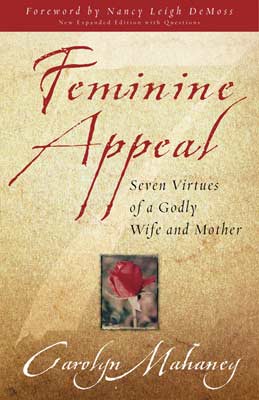
As a new mum, I gradually realised that my focus needed to shift from formal ministries outside the home (which I had to lay aside for a few years) to loving my husband, teaching and training our children, and caring for our home. The book that helped me most with this was Carolyn Mahaney's Feminine Appeal (the first book I blogged through). She introduced me to Titus 2:3-5 and God's call to love husband and children, care for our home, serve people in our church and community, and teach and encourage younger women.

Runners up: Elizabeth George's A Woman After God's Own Heart (not because it's the best but because it was the first book like this I read, so it had an enormous impact on me) and Sharon James God's Design for Women (because it's perhaps the best).

Friday, September 9, 2011

the idols of a parent

There’s nothing like parenting to reveal your true values.

My 12-year-old daughter started secondary school this year. It’s an anxious time for any parent. Your mind fills with questions: will she settle well into her new school? How will she cope with the extra homework? Will she make good friends? Will she make any friends?

During the first few months of the school year, I found myself passionately wanting the oddest things (and talking about them passionately to my husband, who will confirm that I became just a tad neurotic). It seems I want my daughter to:

  • be popular (I want people to like her) but not too popular (I don't want her to be overly influenced by her peers)

  • get all her work done, on time, to a high standard (I don't want her - or, more tellingly, me - to lose face)

  • dress trendily (I don't want her to look daggy) but not too trendily (I don't want her to be a fashion victim)

  • be friendly to the unpopular kids (I want her to be kind) but not too friendly (I don't want her to be unpopular by association)

  • keep to a high(ish) standard in her piano practice (I want her to be accomplished, but I'm not one of those pushy mothers)

  • be upfront about her faith (I want her to stand up for Jesus) but not too upfront (I don't want the other kids to think she's weird)

  • be happy at school (I don't want her to be unhappy) but no so happy that she hates being at home (I want her to love me as much as ever)

  • go to church even when it’s not fun (I want her to learn to serve) but also to have fun there (I don’t want her to hate church)1

Sorry about all the double negatives; but the truth is, there are a lot of bad(?) things I don’t want for her. Especially, it seems, unpopularity (probably because I was a bit of a dag myself, and hated it; like most parents, I visit my own disappointments on my children).

These desires lead to all kinds of strange behaviour. Like constant, nagging reminders about homework and music practice. Like asking my daughter if she needs more fashionable clothes (gulp!) and exploring the trendy teen stores a week before she goes to camp. Like frequent, irritating questions about her friendships. Like talking a lot, in front of her, about whether our church serves her needs.

After all this, there’s no doubt in either of our minds about what matters to me.

So what matters to me? What am I communicating to my daughter are the significant things in life? It seems these things are far more important to me than I realized:

  • popularity

  • trendiness (where did that come from?!)

  • academic success

  • impressing people

  • achievement

  • happiness

  • having your needs met.

Some of these goals look innocent enough. Who wouldn’t want happiness and academic success for their children? But without me noticing, these goals grow bigger than God. I worry and nag. I spend more than I should (and teach my daughter to do the same). I get angry and impatient. I talk about things that don’t matter. I try to shape my daughter to my desires. Our relationship, predictably enough, suffers; and her godliness suffers too.

Acceptance. Achievement. A good education. What I want for my children, I want for me.

As so often in parenting, it’s time for repentance. It’s time to confess my idolatry to my daughter. It’s time for some honest conversations about what really matters: serving rather than being served, valuing inner more than outer beauty, caring for others even if you lose face, choosing friends wisely, pursuing godliness over success, and standing up for Jesus even when it makes you unpopular.


1. When my daughter was younger the idols were a little different: the approval of parenting experts, a child whose behavior impresses others, an ‘educational’ toy collection – just to name a few. (And a good night's sleep, of course.)

This post first appeared on The Briefing today.

image is by mermay19 from flickr

Wednesday, June 1, 2011

a question for you: lazy around the house?

After all that talk about housework and work, it seems a good time to ask you a question from a friend. (My friend, by the way, is pregnant with her second baby.) This is an issue I struggle with too, so we'd both love to hear your advice!

I want to ask how you organise your time? I know we're at very different stages of life, and I shouldn't aim at being some kind of supernatural wonder woman, but sometimes I feel like I don't get anything at all done, and it's mostly because I'm disorganised and generally lazy about things around the house - it's so easy to be lazy at home when nobody else is watching! Of course, that then leads to guilt about not getting things done... I've also just read Shopping for Time, so I'm starting to try to implement some of their suggestions, but is there any extra advice you could give?
Have you ever felt like this? Have you got any suggestions? Share your experiences and ideas here.

image is by Aunty Cookie (very appropriate!) from flickr

Wednesday, May 25, 2011

housework has a 'work' in it

It's funny how the me of the past can surprise and challenge the me of the present.

Usually, I regard the me of the past with a little disdain. Haven't I moved from there? Was I really so worried about that issue? Oh, please!

But sometimes the me of the past floors me with her (my?) wisdom - a wisdom I lost somewhere along the way. This happened to me recently when a friend sent a suggestion for a blog post:

I remember when I was first home with my first child, that you helped me greatly by suggesting that I work at the housework consistently through the day with a few breaks rather than completing a job and then stopping.
I said what??? And (embarrassingly) how seldom have I lived up to this since? Of course, there's nothing magical about my then-approach to housework, but it's a helpful pattern.

But it's what my friend added next that really helped me:

I have found it much better for my mood to see the house and kids as
something I work at all day not just when a need arises.
Now that's helpful.

It's relatively easy to work when you're at work. The boss is watching, there are people around, and you'll eventually get fired if the job's not done. There are clear expectations, clear tasks, and clear achievements.

It's not so easy with housework. You have to be self-disciplined and self-motivated (or visitor-motivated). No-one cheers you on. You do it, then do it all over again the next day - and the next.

Like all work in this fallen world, housework can feel like unrewarding drudgery. Probably more so, because (or so the voices in our heads tell us) who wants to be a housewife these days? Shouldn't my husband be doing as much as I am? Isn't there something more meaningful I could be doing with my time?

So we swap anecdotes about how little we do, boast about how much our husbands do, squeeze housework into increasingly smaller portions of time, and look down on our house-obsessed friends. I know, I've done it. (And yes, while you can turn housework into an idol, my tendency is to go too far the other way.)

So I like what my friend says. I like the idea of treating this wifing / mothering / housework thing as my job, not an annoying intrusion into work, ministry and relaxation. Because this is my work (or part of it, anyway). This matters. This is valuable. This requires generosity, self-discipline, grace - and a pair of strong arms (Prov 31:17).

Thanks, friend, for the reminder that housework has a 'work' in it.

If you enjoyed this, you might enjoy:
a tale of two mornings
cleanliness is not next to godliness

Thursday, April 21, 2011

there are many ways of being a godly woman

There are many ways of being a godly woman.

In my mind there is the one way. Her house is clean and uncluttered. Her washing is neatly folded and placed in tidy drawers. Her children are well-behaved (and if they're not, she has her discipline system all worked out, and applies it without anger and with consistency). She gets up at 6 every morning to read her Bible and pray. She's a brilliant cook, turning out healthy meals and home-made cakes. Her family eats with candles and napkins, and discusses helpful topics as they use their knives and forks. There's no pile of un-dealt-with school notices and ancient-things-she-meant-to-get-to-years-ago next to her phone.

There are many ways of being a godly woman.

I visited a friend the other day. She confessed that her cooking reached an all-time low last year when she made toast for her family's main meal - and burnt the toast. She has a large family, and the house isn't huge, but there's often a boarder living with them, and you'll usually find some of the local kids hanging out. She works in ministry, sleeps until 8 every morning, and the kids do their chores before she gets up. She's brilliant with a paint-brush or a spanner. When people arrive at the door, she laughs at the mess and asks them in. She has gifts of evangelism I can only dream of, and loves, chats and gently hectors her friends into the kingdom.

Put her in the domestic goddess box, and she sticks out all over the place.

I can't live up to her. I can't live up to the domestic goddess either. But I can be me. I can be the godly woman God made me to be.

With God's help I can, anyway.

And yes, before you ask, I know there are lots of non-negotiables in being a godly woman, some of which I wrote about in this series. But lots of variety too, depending on personality and circumstances!

Tuesday, December 14, 2010

woman to woman (7) conclusion: becoming an older woman

This is the final post in my series woman to woman. It's about the woman I want to become.

When I think about growing older (something I'm increasingly aware of!), these words by John Piper remind me of who I want to become:

One of the challenges I repeatedly hold out to the people of our church—especially the women—is that they make it one of their aims to age into a sage. I love the vision of older women full of seasoned spiritual fruit that comes only with long life and much affliction and deep meditation on the Word of God. So many younger women yearn for older women, who are deeply wise, to share the wisdom God has taught them over the years.

When I was a young woman, I longed for the encouragement of an older woman. As I grow older, I hope to become the kind of woman I longed for. I hope to fill this gap in the lives of young women around me.

This isn't just my dream. Every Christian woman has a responsibility to help women who are younger in age or in the faith to grow in godly womanhood. If you're a Christian woman and this doesn't lie close to your heart and shape your priorities, you need to ask yourself why. We don't all have the same gifts—we will respond to God's call in Titus 2 in different ways—but our Lord Jesus Christ has committed younger women to our care.

The desire of my heart is to see a new generation of Titus 2 women in our churches—older women who devote themselves to teaching and training young women. Wouldn't it be wonderful if you and I committed to asking God to raise up women like this? In the meantime, let's be the answer to our own prayers.

Quote is from John Piper When I Don't Desire God 109-110.

This series is based on my article Woman to woman: Answering the call of Titus 2.

Thursday, December 9, 2010

woman to woman (6c) getting practical: everday ideas for women encouraging women

Here's my final list of practical tips for women encouraging women. This time, they're for younger women. It's easy to complain there's no-one to mentor us, but too often, we don't notice the women God has given us. How can we seek encouragement from older women?

3. As the younger woman

  • Remember that you can learn from older women even when they're not theologically informed or trained in formal ministry. Respect older women and what they've learned and have to offer. Listen.
  • Attach yourself to older women you respect, and ask questions. Seek out women who are standing firm in their faith, who have persevered through suffering, who have a heart for evangelism, who have raised their children well, who respect their husbands, or who trust God through long-term singleness or childlessness. Write down questions to ask them.
  • Ask an older woman to mentor you, to read a book with you, or, if it's less intimidating, to pray with you. Older women may not realize what they have to offer, or may not want to push themselves forward. It may be up to you to take the initiative.
  • Find an older woman who excels in a particular kind of ministry—hospital visitation, walk-up evangelism, cooking for large gatherings—and ask if you can go along to learn from her.
  • Call an older woman and ask for advice and prayer the next time you struggle to pray, manage your time well or love those you live with.
  • When there are no older women available, seek mentoring from a distance. Read biographies of Christian women who stood firm. Read books and listen to talks by Christian women.

Any other ideas?

Thanks, Jenny, for the idea for this post.

image is from stock.xchng (I think!)

Tuesday, November 30, 2010

woman to woman (6b) getting practical: everday ideas for women encouraging women

Here are some more suggestions for women encouraging women, this time for those of you who have an official (or unofficial) role in your church facilitating relationships between older and younger women.

2. As the facilitator

  • Speak respectfully about older women in your church. Model this respect to others.
  • Build bridges between younger women and older women in your church. Organize mixed gatherings. Prompt older women to contact younger women. Include women of different ages in prayer partnerships and Bible study groups.
  • Organize seminars for women with speakers you can trust. Run a book club for women. If you run a Bible study, occasionally run topical studies on areas of interest to women.
  • Remember how isolated many single and childless women feel. Run women's events and Bible studies at times that suit working women. Organize get-togethers for women without obvious friendship groups.
  • Train women in Titus 2 ministry and mentoring. If you don't have the skills to train them, find someone who does and ask them to lead a training day at your church.
  • Mentor a younger woman and encourage her to mentor someone else.

Any other ideas?

With thanks to my friend Jenny, who came up with the idea for this post.

image is from sashamd at flickr

Thursday, November 25, 2010

woman to woman (6a) getting practical: everday ideas for women encouraging women

Here's a brilliant list of suggestions for older women seeking to encourage younger women. My friend Jenny, queen of lists, came up with this one. Add your own ideas!

What's your place in women's discipleship? Do you see yourself as a young woman, an older woman, or a facilitator of discipleship relationships between younger and older women? It's likely you fit all three categories! Whichever group you belong to, here's some practical suggestions.

1. As the older woman

  • Talk about yourself. Share your life, thoughts, and struggles. Let younger women “see your progress” (1 Tim 4:15).
  • Ask lots of questions. Listen. Be interested. Be slow to give unsolicited advice.
  • Tell women what you've been reading or thinking about. They might not say much, but they are listening.
  • Keep on hand some favourite books to lend or give away. Ask follow-up questions. Read a book about womanhood with a younger woman.
  • Share how you read the Bible and pray. Talk about how you deal with temptations to worry or gossip.
  • Invite women into your home. Let them see how you run things. Teach a young woman how to make and keep a budget. Don't try to make your house look perfect.
  • If you're married, welcome a single woman into your family, especially on difficult occasions like New Year's Eve. Let her see your struggles so she doesn't idolize marriage and family life.
  • If you're single, model godliness in long-term singleness: show how your trust remains firmly in the Lord and how you serve him in your circumstances. Model godly relationships with the opposite sex.
  • Give practical help to younger women. Look after a single mum's kids. Ask an international student over for dinner. Visit a depressed woman every week. Clean or do a load of washing for others during times of stress.
  • Enlist young women's help in helping others. Spend a day together cooking casseroles for people in your church. Visit an old peoples' home. Teach Sunday school together.
  • Be generous with praise and encouragement: “It's great seeing you reaching out to women at work” or “Your children are a delight. You're doing just fine; hang in there.” But don't flatter for the sake of it.
  • Be intentional when you go to church. Sit next to a younger woman and ask how she's going as a Christian. Pray for the women at church.
  • Befriend the teenage girls in your church. Go to the young people's service.
  • Be involved in women's lives. Ring them up. Remember their details and ask about them.
  • Write a younger woman an encouraging note, telling her how you've seen her grow in godliness.
  • Call a young woman each week and ask how you can pray for her.

Any other ideas?

These suggestions are based on a list created by my friend Jenny Moody, with input from Carmelina Read, Alison Payne and Karen Beilharz. I've also drawn on Susan Hunt's Spiritual Mothering, an excellent source of practical ideas for women's ministry to women.

image is from dr. zaro at flickr