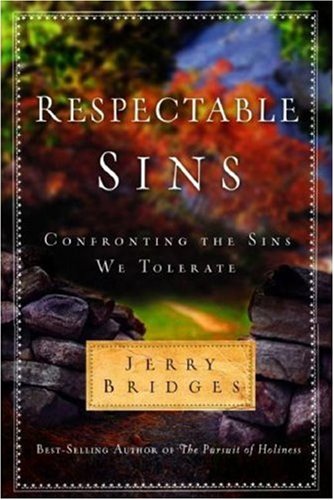
I have been very much encouraged and challenged by these blessedly short, clear blog posts by Nicole over at in tandem on the book Respectable Sins by Jerry Bridges.
I encourage you to click on the following links if you struggle with:
ungodliness
anxiety and frustration
discontentment
unthankfulness
pride
selfishness
lack of self-control
impatience and irritability
anger, resentment, bitterness, holding a grudge, hostility and strife
judgmentalism
envy, jealousy, competitiveness and control
sins of the tongue - gossip, slander, critical speech
worldiness
Have I missed anyone?!
Showing posts with label Jerry Bridges. Show all posts
Showing posts with label Jerry Bridges. Show all posts
Wednesday, September 22, 2010


Monday, August 23, 2010
what I'm reading: not needing to make sense of it from in tandem
 When bad things happen, I try to work out why. This isn't just when big things go wrong, but also during the small inconveniences of life.
Why can't I find a parking spot when we're already late for school? Why did our car battery go flat? Why have I got a cold? What is God trying to teach me? As you can imagine, asking "why?" can get very exhausting.
The following words jumped out at me when in tandem arrived in my inbox last Monday. They're from one of my favourite books, Respectable Sins, by one of my favourite authors, Jerry Bridges, introduced by Nicole :
Bridges actually says that we don't have to work out the exact way that God might use a painful event, but we:...are to give God thanks that He will use the situation in some way to develop our Christian character. We don't need to speculate as to how He might use it, for His ways are often mysterious and beyond our understanding. So by faith in the promise of God in Rom 8:28-29, we obey the command of 1 Thess 5:18 to give thanks in all circumstances.
I've been trying to remember this. When the traffic lights are red, or I break my favourite mug, or my child wakes up vomiting, I don't need to know why. What I do need to know is that God is sovereign, wise and good. Instead of trusting my ability to figure out the answer to the question "why?", I need to trust in Him.
Brought to you courtesy of in tandem.
Thursday, May 28, 2009
Jerry Bridges on the fear of God
 I've waited until now to share this helpful quote with you because I wanted to first work out what I thought about "the fear of God". It's from Jerry Bridges' wonderful book The Joy of Fearing God.
Jerry Bridges defines the fear of God as "reverential awe", a complex mix of emotions and attitudes which leads to a changed life.
What is awe? ... The dictionary I have defines awe as:Jerry Bridges The Joy of Fearing God pp. 18, 25-31, emphases are his.
- An emotion in which dread, veneration, and wonder are variously mingled.
- Submissive and admiring fear inspired by authority.
- A fearful reverence inspired by deity.
You can easily see that, depending on the situation and the object of awe, it could include the emotions of fear (or dread), respect (or reverence), admiration and amazement. ...
A profound sense of awe towards God is undoubtedly the dominant element in the attitude or set of emotions that the Bible calls "the fear of God." A popular definition of the fear of God is "reverential awe," ... a good definition. ...
[W]e need to move beyond equating the fear of God only with being afraid of Him. We must not drop that aspect altogether, since even for the Christian it remains an element in the over-all concept of fearing God. But it is by no means the dominant element. ...
This kind of fear obviously goes beyond simply being afraid of God, for it yields within us such glad responses as adoration, love, honour, and worship. And I would add that these responses are ... not only to God's "transcendent majesty and holiness" ... but also to His amazing grace and unfathomable love for us in Christ.
... Sinclair Ferguson has made a helpful distinction between "servile fear" and "filial fear". ... Ferguson explains servile fear as "the kind of fear which a slave would feel towards a harsh and unyielding master." ...
In contrast to servile fear, filial fear is the loving fear of a child toward his father. Ferguson describes it as "that indefinable mixture of reverence, fear, pleasure, joy and awe which fills our hearts when we realize who God is and what He has done for us." This is the only true fear of God. ..
Is this fear of God a mix of various emotions, or is it an attitude? Emotions are feelings that come and go ... while an attitude is a more or less settled state of mind. Into which category does fearing God belong?
The answer is both. Emotional feelings of awe, reverence, honour, and adoration will definitely be stimulated within us as we have great thoughts about God ...
At the same time our fear of God must be a settled state of mind - an attitude of awe, reverence, honour, and adoration, a fixed mental outlook that isn't dependent on feelings that come and go. ...
Properly fearing God is more than just a feeling or attitude - it's a feeling or attitude that changes our lives.
Friday, March 27, 2009
Spurgeon, Welch, Adams & Bridges speak about "the fear of the LORD"
 You'll remember that on Monday, I began my definition of "the fear of the LORD" like this:
To fear the LORD is to submit to him as the one true God, with trust, love, worship, honour, service and obedience..You might be wondering what all this has got to do with "fear", and fair enough. I'll try to answer that question soon.
In the meantime, I thought you might like to know that I'm not alone in defining "the fear of the LORD" like this. Here are some great theologians who say things along the same lines.
Dr. Jay Adams defines the fear of God as “loving and respectful obedience toward Him” (cited by Elyse Fitzpatrick in Overcoming Fear, Worry and Anxiety p. 145).
Charles Spurgeon says, in his sermon Godly fear and its godly consequences,
What is this fear of the Lord? The expression is used in Scripture for all true godliness. It is constantly the short way of expressing real faith, hope, love, holiness of living, and every grace which makes up true godliness.Dr. Ed Welch, in his very helpful book When People are Big and God is Small, writes
This fear of the Lord means reverent submission that leads to obedience, and it is interchangeable with 'worship', 'rely on', 'trust', and 'hope in' (p. 19).Like Spurgeon, he goes on to say lots about the attitude of "fear" - but we'll leave that until next week!
And Jerry Bridges, in a fantastic interview with Peter Hastie about The Fear of God which didn't quite make it into The Briefing, says:
Deuteronomy 10:12 links fear, love and obedience together. Moses says to the Israelites: “What does the Lord ask of you but to fear the Lord your God, to walk in all His ways, to love Him, and to serve the Lord with all your heart and with all your soul?” He brings those three terms—to fear God, to love Him and to serve Him all together in the one passage. And the way the terms are used, it's almost as though they are interchangeable expressions.Jerry Bridges, by the way, wrote a whole wonderful book called The Joy of Fearing God. It's well worth reading if you want to know about "the fear of the LORD", or if you simply want a bigger, more awe-inspiring view of God.
Subscribe to:
Posts (Atom)