Showing posts with label seasons of life. Show all posts

Tuesday, May 14, 2013

when life feels oh, so ordinary

My life feels ordinary. I guess yours does to. And so often we long for more. Or we wonder if we're missing out on something. Or if we could be serving God in bigger ways.

Challies tackles this feeling in Ordinary: Christian living for the rest of us.
Ordinary is a book I have lived. I live it every day. I live an ordinary life, pastor an ordinary church full of ordinary people, and head home each night to my ordinary little home in an oh-so-ordinary suburb. I preach very ordinary sermons—John Piper or Steve Lawson I am not and never will be—and as I sit with the people I love I am sure I give them very ordinary counsel. A friend recently confessed his initial disappointment the first time he visited my home and got a glimpse of my life. “Your house is so small and your life is so boring.” Indeed. It’s barely 1,100 square feet of house and forty hours every week sitting at a desk...

I want to explore this desire to be more than ordinary and this low-grade guilt that compels us to try to do more and be more and act more. I am convinced that we do not need to make ordinary synonymous with apathetic and radical synonymous with godly. I want to explore some of these themes because I encounter them in my own life, I see them in the pages of bestselling books, I hear them at conferences, I counsel against them in the people I pastor, and I often battle to convince my own wife that ordinary is good. It is all God asks of us. It is all God asks of her.

And here’s the thing. I am thrilled to live this ordinary life. Nine days out of ten I wake up in the morning overwhelmed with gratitude that I get to live a life like this. I live it without guilt and regret. I live without the desire to be extra-ordinary and without feeling the need to do radical things. But then there is that other day, that one out of ten, where I feel guilt and discontentment, where I want life to be so much more than it is, where I am convinced that I am missing out on a better life and missing out on God’s expectations for me.

Ordinary is Christian living for the rest of us. It is for people like me and, in all likelihood, people like you. It is for Christians who have tried to be more than ordinary and who just have not found what they have been looking for. It is for Christians who have never tried to be more than ordinary and who are content that way. It validates our sheer normalcy and refutes our desire to be anything greater than that.

It is about being ordinarily excellent, ordinarily passionate, ordinarily godly. It is about trusting that such ordinary saints are saints indeed, fully acceptable, fully accepted, fully pleasing to the One who created and called us.

I think we may just find that this desire to be more than ordinary and to live a life so much more than ordinary exposes as much sin as sanctification. Perhaps we will find it is one thing to pursue godliness and end up with extraordinary challenges, extraordinary responsibilities or extraordinary opportunities, but another thing altogether to pursue the more-than-ordinary as a goal. We may well find that the Christians who really get it are the most unremarkable of all.

You can read the rest here.

Tuesday, February 14, 2012

when all your kids go to school

I've been writing and re-writing this post in my head. How do you sum up the end of one season of life and the beginning of a new one? The answer is: you don't. But here are a few thoughts that occur to me.

Well, I've finally done it. Thirteen years of parenting, and my youngest is in school. I can't quite believe it. I catch my breath, and the world spins by.

There's a mixture of grief and relief. Grief that my littlest boy will no longer be around, asking me to play. Grief for those small interruptions in my day when I downed tools and sat down for a jigsaw, a book, a game - or just a cuddle. I see young mothers pass by, holding their toddlers by the hand, and my own hands felt empty.

But I won't deny that I also feel relief. Relief that - finally! - there is a stretch of time in my day when I can just be. Be by my blessed self. Like all introverts, time alone is - well, how can I put it? It's a bench where you catch your breath on an uphill hike. It's a clearing in the forest where you lie back and disappear into the sky. It's the plunge of hot skin into an icy stream. (Sorry about the purple prose, but that's how I feel about time by myself. Purplish.) Without solitude, I grow small and shrunken. I gasp for breath. I prickle.

There are benefits for the kids, too. When they get home from school - wonder of wonders! - I actually feel like spending time with them. Instead of fighting the urge to escape to the computer, I sit on the couch with my daughter and we chat like civilized grown-ups. I make milk-shakes with energy instead of reluctance. I ask my sons if they want to play a game, and they're the ones that refuse me. Not sure how I'd do home-schooling!

As for those thirteen years with young children at home, I've realised one thing: they were really tough! If you're in the middle of them, here's my advice: don't be surprised or dismayed if you're exhausted and get nothing done. I got some medical tests a year ago to work out why I was so tired. They came back with every box ticked: yes, I was in perfect health. I was just plain tired. With every year that passed, every child that was born, I got tireder and tireder. I got less and less done. That's just the way it is during that season.

(But oh, the joys! The naked new babies with their soft, wrinkled skin and that indefinable new-baby smell. The ridiculous pigtails askew on my toddler daughter's head. The tender curve of a boy's head under his newly-cut hair. The books - endless books! - that we read together. The games that we played, and the tumbling wrestling cuddles.)

This new season isn't all blessed solitude and after-school reunions. There's a vagueness to my days that disturbs me. You see, I've decided not to take on huge new work or ministry responsibilities - not yet. I've been advised by many friends to treat this as a year of recovery and adjustment: a year of grace. I want to feel my way into the shape of my days before I take on new tasks.

I like control. I like structure. I grow tired of the question, "What are you going to do now the kids are all at school?" It's not easy for me to sit lightly to order and organisation and regular commitments. But I think this is where God wants me this year, and perhaps for many years: being present for my husband and growing children, making a home, giving time to relationships outside the home (Titus 2:3-5, 1 Timothy 5:9-10). If life is vague and unstructured - if, at times, I feel like a waste of space, or like I'm lost in space - well, God knows and determines my path. I'm learning to put my hand in his and feel for each step of the way.

The days slowly fill. I invest in relationships with neighbours and mums at school. I get to know younger women at church. I look around the house, and all the jobs I didn't do during the last thirteen years vie for my attention. I read the books I haven't had time for. I write. I'm grateful for space to do these things. I'm sure they will gradually coalesce into some kind of routine.

So what will I be doing this year? I wrote down three words in my journal the other day: "Wait. Trust. Depend." That seems like a good place to start.


image is by from flickr

Wednesday, September 7, 2011

for grandmothers who look after their grandchildren

I keep bumping into grandparents at school and pre-school who are dropping off or picking up their grandchildren. Often they have a weary look! The reason for this becomes clear as we chat.

One bent-over elderly woman raises her two spunky, energetic granddaughters full-time because her daughter isn't capable of caring for them.

One woman who looks to be in her fifties or sixties has 5 (yes, 5!) grandchildren aged 5-16 living at her house - and I can tell you, the 5 year old is a handful!

One woman (and this is a composite) cares for her grandchildren 1/3/5/7 days a week (not excluding weekends) because her daughter/son(s) and son-in-law/daughter-in-law(s) work part/full-time.

They've raised one generation, and they're helping to raise another. They're older and tireder this time around. They probably weren't expecting this. But they do it out of love for their grandchildren - and sometimes from a sense of desperation (who else will do it if they don't?) - driven by the changing patterns of society, and by their children's choices, desires and/or needs.

I was encouraged this morning to read this blog post, addressed from one godly woman in this situation to other women in this situation:

Nana Nanny.

Enjoy!

Wednesday, October 20, 2010

in times of change

I wrote this back in May this year. I'm not sure why I didn't post it. I remember feeling a little unsure about its value to others. But it seems helpful to me now, and it encourages me as my life continues to change, so here it is.

The other day we took our kids to the local park and let two helium balloons, which the kids had given me for mothers' day, drift into the sky. The pale blue balloon soon disappeared behind the trees, but the yellow one twisted and turned on the high winds, growing smaller and smaller until it became a shining dot in the late afternoon sun, winked, and vanished.

As I watched the balloons disappear, I felt like they were carrying a season of life away with them. I've been checking out high schools for my 11 year old daughter, the same daughter I remember sitting with for hours as a 2-year-old, reading picture book after picture book. Every time I look at my 3-year-old, I'm reminded that in a couple of years he will go to school, and I'll be alone during the day - something I long for and dread in equal measure - and that a year or so after that, there will be no more small children at our house.

This is a time of change for me. I'm uncertain about the future. I don't know what shape life will take in a year, or 3 years, or 5. You don't realise how dependent you are on a carefully sculpted future until it's no longer certain.

My sister in Christ reminded me the other day that God doesn't change. The God I pray to is exactly the same God as the one who spoke the world into being - who spoke to Moses out of the burning bush - who watched his Son die on a cross. She talked about how, sometimes when she's praying, she thinks of this and can't wrap her mind around it.

Like a balloon unattached, I'm floating, drifting. Unsettled, afraid. But I remind myself that my certainty doesn't rest in the things around me. My certainty is anchored in Christ, seated at the right hand of the Father, unchanging, praying for me before the throne (Rom 8:34; Heb 7:25).

Whatever else gives way, he is certain.

image is from incurable_hippie at flickr

Monday, October 11, 2010

what I'm reading: when our hopes are disappointed from The Briefing

Here's a wonderful reminder, from a woman battling long-term illness, that when life goes in a different direction to what we expected - when we struggle with broken dreams and disappointed hopes - when we're in the middle of a difficult season that doesn't seem to end - God is still faithfully working in our lives for his glory.

I had so many plans, hopes and dreams for my days on this earth, but I'm learning I'm to surrender even these to God. I thought I had good plans, but God's promise is that his plans are best. He's reminding me that the main purpose of my life isn't to necessarily do all these things (though I would greatly enjoy that!), it's to bring glory to my creator and Saviour, whatever my life looks like. My hopes and dreams seem distant, and often even dead, but God's work of shaping me into Jesus' likeness has been made even more alive by this trial (1 Pet 1:6-7). May I accept that he is the one that chooses how he will use me for his glory. I need to want for my life what God wants for my life (Matt 6:9-10), even when that means missing out on things I deeply desire, and to learn that there are more important things than what I think will make me happy or successful.

From the Briefing article "Giving up your life" by Rachel Pettett, who has suffered from Chronic Fatigue Syndrome for 3 years.

image is by sweethardt from flickr

Wednesday, June 23, 2010

Jenny's reflections: when all your kids go to school

And here's more reflections on the year your youngest child goes to school, from Jenny at No Reading at the Breakfast Table. I find myself going back again and again to her post What are you DOING?, about what it's been like adjusting to having no children at home. She says,

Over summer, I had a standard reply to everyone's questions about what I was going to do with ALL my spare time. I said that I planned to sit down, have a cup of tea and just stare at a blank wall for a while. In reality, it feels like three weeks ago I sat down, starting staring at the wall and then couldn't get up again - worn out from a decade (plus) of constant demands! Still haven't tidied up that play room properly yet.
That's exactly how I feel, "worn out from a decade (plus) of constant demands". My feelings are a mixture of exhaustion (and I've still got a year to go in my young-child-rearing marathon!), anticipation (how I long for a few uninterrupted hours a day!), and apprehension (how I will miss having small kids at home!).

There's a kind of hollowness too, as the thing that has defined me and filled every spare moment for so many years - being pregnant and caring for very young children - is coming to an end. Who am I? How does God want me to use the years remaining to me? Will life always be this tiring? Very mid-life-crisisy, I know! But I'm realising that these are common feelings and questions for women during this season of life.

I'd love to hear your thoughts. If you're at this time of life, with your youngest child soon going to school; or if the transition has happened for you recently, or even a long time ago; or if you're anticipating it in a few years - how do you feel about it? What's your story? What are the issues you've had to deal with?

Enough rambling. More about all that another day (and yes, I do plan to come back to this issue, so please share your reflections with me!). In the meantime, you'll enjoy Jenny's posts:

Two Days, No Kids, Very Weird
Overscheduled Kids or Overscheduled Mum
What are you DOING?
Adjusting to Change (Badly)
PS to Adjusting to Change (Badly)

HT Meredith

image is from Jenny's most excellent blog No Reading at the Breakfast Table

Monday, March 29, 2010

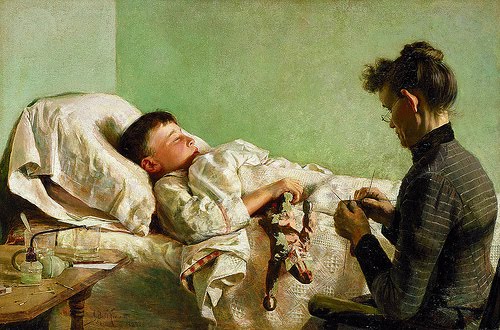
what I'm reading: caring for the sick from Edith Shaeffer's What is a family?

Edith Shaeffer has truly been an older women to me while my son Ben has been ill. Her chapter "A Shelter in the Time of Storm" in What is a Family? has taught me how to care for a sick child, and reminded me that I can only do my best in the midst of life's demands - very comforting when I feel inadequate! Here's what she says about the enormous significance of caring for the sick.

For some people the memory of illness carries with it the memory of loving care, cool hands stroking the forehead, sponge baths in bed, clean sheets under a hot chin, lovely-flavoured drinks, alcohol back rubs, medicine given methodically by the clock, flowers near the bed, curtains drawn when fever is hurting the eyes, soft singing of a mother’s or father’s voice during a sleepless night. ...

What is a family? A family is a well-regulated hospital, a nursing home, a shelter in time of physical need ... A family should be a training place for growing human beings to know how to care. ...

When illness hits we should remember that this period of time is part of the whole of life. This is not just a non-time to be shoved aside, but a portion of time that counts. ... The opportunity to do something practical about making you family remember their sicknesses with a feeling that yours was the "best hospital in the world" ... gives purpose to some of the drudgery of changing beds, struggling with bedpans, cleaning up the sickroom floor, or thinking up something comforting to do. ...

So nobody has cared for you? Well, you can begin to start a long line of people caring for people. Isn't that a worthy part of your career?

There is never a series of little packages of time given to you in life labeled: TIME FOR AN ILLNESS, TIME FOR A WEDDING, TIME FOR A DEATH ... You can't face the sickness, the operations, the broken arms and legs, the serious diseases, the disasters, or even the headaches, unless you realize there is never a convenient time set aside for joy or sorrow, protected by neat little walls so that the two things will not mingle and spoil each other. ... Life has to go on, and we can only do the best we can in the melange ...

A family should be a place where comfort is experienced and understood, so that the people are prepared to give comfort to others.

from chapter 5, "A Shelter in the Time of Storm", in Edith Schaeffer's What is a Family?

image is from painting by J. Bond Francisco photographed by freeparking at flickr

Tuesday, March 16, 2010

busyness, stress and the grace of God (2) seasons

It's September 2007. I'm sitting in the living room with two of my dearest friends. Our youngest children are no longer babies, and our minds turn to the future, to the world beyond our front doors. What do Christian women need? How can we encourage them? Together we dream about the next season of life. The possibilities run around my head until one morning I wake up with a newly-minted idea: start a blog! After that, who knows? Writing? Seminars? Conferences? They're only a dream away.

I get too busy when I ... forget which season I'm in.

What I was thinking. "I'm starting on a new season of life. I'll have more time now. It's time for dreaming! What exciting new ministries can I get involved in?"


What I'm learning.
1. You can't hurry seasons.
Women's lives, even more than men's, are divided into seasons. Each season takes as long as it needs to, and you can't move onto the next until it's over. Older women are always telling me how short this season with young children will be, and that there will be more time for new ministries in the next. I'll take that on faith: it doesn't feel that way to me! But I'm learning to be patient and content with this season; to rejoice in its unique possibilities and responsibilities; and to trust God with the slowness of the next season's coming. Why would I hurry this precious season?

2. It's easy to underestimate a new season's demands.
Looking back, there was a remarkable lack of wisdom in my timing. Four children, with the youngest barely a year old, is hardly the time for grand plans about lots of new ministries! (Yes, I am glad I started this blog, but what came next is another story ...). It's the same when your youngest child starts school: many women throw themselves into work and ministry, without realising how demanding the next season of life will be. Which leads to my next point ...

3. At the start of a new season, take time to recover and reflect. Here's some excellent advice I've heard: when your youngest child goes to school, have a quiet year before filling in your "extra" time. Until you've lived in the next season, you won't know how demanding it is. And I'll need time to recover after 13 exhausting years at home with young children. Take time to rest and reflect, and step cautiously into new ministries, knowing they'll expand to fill more time than you expect. (This isn't an excuse for laziness or selfishness, but a reminder for those of us who eagerly say "yes" to everything to take care.)

4. Leave room for relationships - and the unexpected.
Women's lives tend to be focused on relationships. That's good and appropriate, but it means our plans will be frequently interrupted. I have a friend in her 50s who works in ministry. Every year of the last 3 years, she's had to cut down her working hours because of unexpected demands: a cancer scare, a dying father-in-law, a sick son in another state, a new grandchild with serious health issues, her husband's change of job. Leave room for relationships. Leave room for the unexpected. Keep your diary lazy. You can always fill your spare time later!

5. Put each season's first things first.
During the season I'm in, my first responsibility after helping my husband is to teach and train our kids; and after that, to serve in our church and reach out to our community. When I take on lots of public ministries, it undermines health and rest, and drains my energy for those God gives me to love. It's okay for outside ministry to put pressure on our family from time to time - that's part of the cost of serving Jesus - but when I'm constantly neglecting my relationships it's time to repent, cut down, and ask God to help me serve him faithfully in the season I'm in. (If you want to think more about this, see my series balancing homemaking and ministry.)

6. God never changes, even when seasons do.
The changeableness of seasons can make us feel unsettled and uncertain. But our security doesn't come from a settled life: it comes from God. Through seasons of grief, seasons of exhaustion, and even seasons which don't seem to end, our God is always faithful, and his sovereign grace and loving kindness don't change.

What do you think? How does being aware of our season of life help us to serve God faithfully, without becoming too busy and neglecting the important things? Are you caring for the people you need to care for in the season you're in?


images are from visuallegedanken, joiseyshowaa and ToniVC at http://www.flickr.com/; image of door with windows is from http://www.sxc.hu/

Tuesday, June 17, 2008

in memory of David

Here's a beautiful poem by John Piper which he wrote about his father-in-law after he died. It spoke so clearly to me about my father-in-law David, who died a month ago yesterday. And about the strong trees and shelters each of us, you and me, can become for others if we allow God to shape and grow us. Take the time to read it. You won't regret it.

Tuesday, June 10, 2008

finding joy when the seasons of life don't end

Life is seasons. Part of wisdom is learning to live within the seasons God gives us. When we're young, we may picture our lives like this: childhood, adolescence, young adulthood, marriage, children, middle-age, empty nest, grandchildren, retirement, old age.

But what do we do when a season of life doesn't end? When singleness, childlessness, an unhappy relationship, chronic sickness, a disabled child's dependence, or a spouse's mental illness, go on and on? When we're stuck in one of the difficult seasons of life?

When young, blonde, sweet-as-they-come Sarah caught Bill's eye, she thought it was the beginning of happily ever after. Sarah revelled in her role as wife and homemaker. She enjoyed cooking and decorating. She loved hanging out, playing games, and laughing with her husband. And she looked forward to what she assumed would be the next season of her life: motherhood.

But the season of motherhood never came for Sarah. It was many years before she realised that it probably never would. Soon after they were married, Bill began suffering severe and debilitating fatigue, weakness, and headaches. After a while he could no longer work. Sarah - this woman who wanted nothing more than to be at home - became the sole breadwinner. Years of doctors, experimental treatments, and special diets availed nothing. Bill only got worse - so sick that he often was unable to leave the house. Finally, Bill and Sarah were forced to move from the church and friends they loved so that they could live in a location that offered a better quality of life for Bill. Gradually, Sarah realised that they would never have a family. This was not the life she had planned. It wasn't what she wanted. She felt stuck in a season that wouldn't end.

Like Sarah, none of us would choose "a time to weep," or "a time to mourn," or a time of sickness - a lifetime of sickness. This isn't what Sarah chose. But it's what God chose for Sarah. Here, inside this truth, Sarah found joy.

No, Bill didn't get better. She didn't become a mother. She still lived far away from dear friends. Yet she came to realise that this life - one she hadn't planned for herself - was the very life God had planned for her. God had designed this long, unexpected, unwelcome season so that Sarah could best glorify him. He had allowed this trial so that he could show his goodness and mercy to Sarah in totally unexpected ways. Sarah found joy when she came to rest in the truth that God orders our seasons.

If you were to meet Sarah, her joy would be immediately obvious. It's a deep joy, infused with peace. And it displays itself in a genuine care for others and continual expressions of gratefulness to God. To be around Sarah is to catch a glimpse of the love and goodness of Christ. Sarah isn't just surviving. She's truly thriving, growing, and rejoicing in the season God has ordained.

This quote made me profoundly grateful (for the first time!) for the passing seasons of life. Even for children who grow out of babyhood - something I usually regard with clinging nostalgia. How hard it would be to care for a perpetually dependent child! What a joy that children grow and change, and yes, even leave the nest.

In a world marred by sin and suffering, it's a blessing that seasons end. That life-long pain, a difficult marriage, or a struggle with besetting sin, are finite. In such a world, even death is not just a grief and a horror, but a safeguard and a release. God puts limits on human happiness, but also on human suffering. They are not forever.

Knowing that seasons pass helps us not to not to cling to happy times, as if youth, or marriage, or children, were the end of our existence. It helps us look beyond earthly joys to what is everlasting. To hold them lightly, and give them up to God when it is time.

Knowing that seasons pass helps us not to despair in dark times, when tears and tasks seem relentless and unceasing. It helps us remember that their end is ordained by God, and his timing is perfect. That "weeping may remain for a night, but rejoicing comes in the morning" (Ps. 30:5). That all seasons end in unending joy for those who trust in Jesus.

God give us strength to serve him in all the seasons of our life, that we may be those who serve him with joy.

The quote is from Shopping for Time: How to Do it All and Not Be Overwhelmed by Carolyn Mahaney and daughters, pp.22-23. Names have been changed to suit an Australian audience.

Monday, May 26, 2008

seasons of life and Bible college

Many of you are studying at theology college, or married to people studying at theology college, and I thought you might find this encouraging. Also any mothers among you, or anyone going through any season of life - which I think covers all the readers of this blog.

It's a Q&A from John Piper's How to Fight for Joy conference talks, which I've been listening to on my iPod. Enjoy!

Q. Do you have any practical advice for seminary students dealing with marriage and work and study and ministry - how to get through that, and to keep your affections with God, and not in all these other things?

A. Resolve to live as simply as you can so that you and your wife can work as little as possible and not burn the candle at both ends. Choose a simple apartment, eat simple food, don't eat out very often, don't go to a lot of movies. Keep your life pressured by things that matter: schoolwork, marriage, kids, health - "physical health does a little bit of good" the Bible says (1 Tim. 4:8). That's the first thing. Try to strip away the non-essentials.

And then, within the essentials, put your time with God in a place and a time that is sacred and inviolable. He does not get the dregs, not even after your wife. Meet him in the morning, and if you have to, get up 1/2 hour earlier. Do what George Mueller did. He said, "The first task of my life every morning is to get my heart happy in God, because I'm of no use spiritually to anybody if I can't share the delight that I have in God." Fight that fight. That's more important than assignments, marriage, children, and health. Keep yourself alive in God. When that's in its place, you can be a better husband, and you can be a better father, and you can be a better student.

If you weren't married, I'd say marry the right woman, namely a woman who can do without you for 3 years! (laughs) It does help to have a wonderfully self-resilient wife who says, "This is a season. This is a season."

Whether you're 60 or 16, life is seasons. There's a season with little kids in nappies. There's a nappy season, then there's a pre-school season, then there's a school season. Life is seasons.

And if you take any one season, then it feels like this is all life is going to be. No. Seminary is not the end of life. It's a tough season. Maximise it. Even the hard things. Maximise the hard things in it, for your own sanctification.

Then you'll enter into another kind of hardness afterwards.