Showing posts with label sin. Show all posts

Thursday, September 12, 2013

when the struggle doesn't end, where is grace?

It took me a while to sort out the gold from this great little post, so I'm giving it to you here:
We like happy endings and success stories, so it's easy to think experiencing triumph is the epitome of the Christian life. The prayers were answered. The sin was conquered. The problem was solved.

But what if He chooses otherwise? What if the battle with sin is lifelong or the circumstances don't change? What if grace not only grants deliverance but gives patient endurance year after year?

Grace may not wear the champion's laurels, but be incognito, dressed in the plain clothes of the long-term struggles of life. God's grace is present and sufficient even when it's hiding in plain sight.

Oh Lord, give me eyes to see!

It's something I've been thinking about a lot recently.

God's grace is for endurance, not for escape. We like to share our success stories, but we also need to share our struggles and the fight to hold on to faith.

That's why I've been writing this series, even though it's sometimes painful.

You can read the rest of the article here. There's lots more gold in it.

Monday, March 11, 2013

give me a broken heart that yet carries home the water of grace

This is one of the beautiful quotes from one of my favourite newly-discovered blogs, Georgianne

O changeless God,

Under the conviction of thy Spirit I learn that
the more I do, the worse I am,
the more I know, the less I know,
the more holiness I have, the more sinful I am,
the more I love, the more there is to love...

My mind is a bucket without a bottom,
always at the gospel-well but never holding water.

My conscience is without conviction or contrition,
with nothing to repent of.

My will is without power of decision or resolution.

My heart is without affection,
and full of leaks.

My memory has no retention,
so I forget easily the lessons learned,
and thy truths seep away.

Give me a broken heart that yet carries home
the water of grace.


From The Valley of Vision.

Monday, October 8, 2012

why God doesn't just get rid of sin

Do you ever wonder why God doesn't answer your prayers and make you instantly holy? I know I do! If God wants me to obey him - which I know he does - and if it's in his power to make me holy - which I know it is - then why do I still struggle with sin?

There have been times, after a long losing battle with sin, when I've glimpsed the answer: humility. When I "succeed" in my obedience (there's a telling phrase!) I get smug and proud. When I fail, over and over again, it humbles me. I need this, because I'm all too ready to think I can get it right!

Here's another, even better answer. I came across it the other day while preparing a Bible study on Romans. It's by David Seccombe:
Over and over again we are disappointed by our own performance. We pledge our day to God in the morning, pray for grace to overcome all trials, and in the evening look back with shame at nasty words and thoughts, greed, pride, cowardice and so on...We may venture the thought that, if God has withheld the grace of instant sanctification, desperately as most Christian would love to have it, it is because there is a greater gain to be had in the lifetime of struggle with evil to which he commits us...The daily reality of sin causes us again and again to look to our Saviour for forgiveness, and to rest our trust in him that we stand accepted by God ever and only because of his gift.
So why does God let me go on struggling with sin? Here's the answer: grace. I didn't just become a Christian by grace; I live in it every day. When I fail, then fail again, it becomes obvious even to me that I can't depend on my own efforts. I'm driven back to the Saviour. That's what sin does. It drives me away from self-assurance and to the foot of the cross.

(There's an even bigger answer: God's glory, and the glory of his Son - Rom 9:22-24, 1 Cor 15:20-28, Eph 1:3-14 cf. Exod 9:16. But that's a post for another day.)


Quote is from David Seccombe Dust to destiny: Reading Romans today 124-127.

image is by Keoni Cabral from flickr

Thursday, November 10, 2011

in my weakness, your growth

None of us wants to be the cause of another person's sanctification - at least, not unintentionally - and yet, so often, that is what we are.1

Is this one of the reasons that God allows us to become weak, dependent and forgetful as we grow older? Is it so we can place a necessary burden on those who were once dependent on us: a burden of forbearance and loving care?

Is this one of the reasons we may have to bear chronic illness or long-term disability? Why we may fight depression or suffer from mental disorders? Why we experience unemployment or material need? We may not want to receive others' charity and compassion, but in giving these, they grow into who they should be.

Is this one of the reasons God gives us personalities both winsome and challenging, attractive and off-putting, charming and awkward? Which of us would choose to have a 'difficult' temperament? But it's our unappealing qualities - uncomfortable thought! - that help others learn to love someone who's hard to love.

Is this one of the reasons we're not yet made perfect; one of the reasons that transformation happens so slowly? As we live with imperfect people, we practise forgiveness and forbearance, giving to them what God has far more generously given to us.

Speculation, I know, and raising all kinds of questions about God's sovereignty and our responsibility (yes, I am responsible to grow in godliness, not to persist in my ungodliness because it might help you grow!). In adversity, faith fixes its eyes on Christ and chooses hope, courage and love, not self-centred neediness (Hebrews 12:1-3). But it doesn't do this by a proud denial of need.

My instinct is to conceal my sin, make excuses for my faults, play to my strengths, and deny my dependence. What if, instead, I admitted my weakness, and gratefully accepted your generosity and grace? What if I served, even when the service wasn't perfect? What if, during times of helplessness and need, I practised contentment and received your help with gladness?

We are not strong; we are weak. We are not sinless; we are sinners. In our attitudes towards those who love and bear with us, we can choose to grow in humility, self-forgetfulness and joy. As we do this, we practise something far more significant: an attitude toward God that helps us to humbly receive his grace.


1. This odd little thought popped into my head while I was vacuuming. I suspect it has its roots in some novels I've been reading by the Anglo-Catholic author Elizabeth Goudge. While there's lots about her theology that I don't agree with, I am often encouraged by her moral insights.

This post first appeared in The Briefing yesterday.

image is by SanShoot from flickr

Monday, October 3, 2011

5 books that changed who I am (5) late 30s

As I continue with this meme about books that have changed me, it seems appropriate to mention a book about change...

(5) late 30s - change and grace
Thirty-five, still battling perfectionism, and still struggling to obey God from a legalistic heart. Increasingly, I felt fearful and on edge; I was battling mild depression; I was struggling with people-pleasing and ambition; and my anxious busyness had driven me to the edge of burnout. So many books helped me through this time; but one (besides the Bible) stands head and shoulders above the rest. Yep, you guessed it...

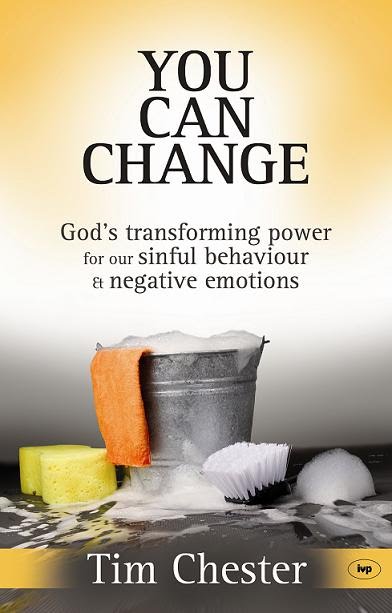
Tim Chester's You Can Change brought me to the foot of the cross, giving me a new joy in God's grace and a new motivation to change. He showed me my heart - the idols of people-pleasing and perfection, and the false beliefs that caused my anxiety and discouragement - and helped me to turn to God's glory and grace. So much heart-change in one book! You may remember that I blogged through it here.

Runners up: Martyn Lloyd Jones Spiritual Depression, Tim Chester The Busy Christian's Guide to Busyness (which I blogged through here), John Piper When I Don't Desire God, Elyse Fitzpatrick Overcoming Fear, Worry and Anxiety, Paul Tripp Lost in the Middle, and anything and everything by Ed Welch, particularly Lost in the Middle: Midlife and the Grace of God, which I'd recommend to anyone of any age.

Which books have helped you to change? Tell us here.

Tuesday, November 9, 2010

how we change (13) a lifetime of change

What do you expect when you pick up a book like You Can Change? Two years ago, when I started reading, I hoped that certain sinful patterns would be broken.

I chose a "change project" I'd been avoiding for years: perfectionism. As I read and worked through the exercises, I thought about self-improvement and proving myself, changing from the heart, grace and legalism, false beliefs and idols, choices and obstacles to change, disciplines and accountability. By the end of the book I'd made some breakthroughs.

It's over a year later, and where am I at? Still fighting perfectionism, that's where! Like all temptations, it's powerful, and it hasn't lessened with time. I have a better understanding of why I struggle and how to fight. Best of all, I've learned to flee to the cross. But I haven't found victory. Every day, I take up my weapons and fight again.

Which is why the final chapter of You Can Change is a great way to finish the book. In it, Chester reminds us that, like a puppy at Christmas, change isn't for a day - it's for a lifetime. "It's a marathon, not a sprint." My sinful nature won't die until the day I die. Until then, every day, every moment, I'll be fighting. There are no days off in this war.

Once, when I found change this hard, I would have despaired. I would have tried a thousand sets of rules and resolutions, and despaired as I watched each one fail. I would have given up, because if I'm not going to change, then why bother? I needed a new motivation for change (grace, not proving myself); a new way to change (grace, not rules); and a new hope for change (grace, not willpower).

Which brings me to the other reason I love the last chapter of You Can Change. It doesn't just remind us that change takes a lifetime; it reminds us that we can change, for we have God's grace. There are two images of God's grace that stay with me from my time reading this book:

  • An image of God's grace surrounding and upholding me like an over-soft mattress (like our rather old mattress, in fact). I'll never forget the night I lay in bed and realised, more deeply than ever before, that I can't do anything to earn or change God's grace: I can only rest in it.
  • An image of a stone rolling downhill. Chester pointed out, back in chapter 3, that change is less like pushing a boulder uphill and more like a boulder rolling downhill. It's harder to stop change than to keep in step with how God is changing me! Change is irrevocable and inevitable, for God's purposes don't fail.
Change is slow, it's up-and-down, and sometimes I can't see it; but it's happening, because God's grace forgives and transforms me. I'll never stop sinning during this life. Every day, I fight for faith and repentance all over again. But God has given me everything I need to change. However often and terribly I fail, I needn't despair. I can change, because God is changing me.

We needn't and shouldn't despair...Sin is never the last word for the children of God. Grace is always the last word...There is hope for change. That hope is not in counsellors or methods or rules. That hope is a great and gracious Saviour who has broken the power of sin and placed his lifegiving Spirit in our hearts.
Amen.

images are from stock.xchng

Thursday, November 4, 2010

Romans 12:1-2 (2) a living sacrifice

Here's part 2 of Steve Chong's talk on Romans 12:1-2, a talk that God used to change my heart. You can read part 1 here.


Therefore, I urge you, brothers, in view of God's mercy, to offer your bodies as living sacrifices, holy and pleasing to God—this is your spiritual act of worship. Do not conform any longer to the pattern of this world, but be transformed by the renewing of your mind. Then you will be able to test and approve what God's will is—his good, pleasing and perfect will. Rom 12:1-2

We've seen that serving is our response to God's mercy.

Serving begins with getting my heart right before God. It begins with
1. getting my body ready ("offer your bodies as living sacrifices")
2. getting my mind ready ("be transformed by the renewing of your mind.")

Let's start with 1.

"offer your bodies as living sacrifices"

"Living sacrifice". We've heard the words so often we don't even hear them. We water down "sacrifice" until it means missing a favourite TV show to go to a Bible study. But sacrifice is about a bloody, dead lamb on an altar. We are the "living slaughtered", our lives used up for the pleasure of God.

The problem with a living sacrifice is that it keeps crawling off the altar.

We say to God, "Yes, Lord, take me, take all of me.........but not......... ______________."

What do you finish the sentence with? What's your disclaimer, your caveat? That's what's stopping you from serving God with all your heart.

We all signed up for this. Have we forgotten?

I went home and finished the sentence. It was ridiculously easy to come up with 5 things that keep me from serving God whole-heartedly, and I'm sure there's more:
1. comfort
2. good standing with non-Christians
3. my children's happiness
4. the good opinion of Christians
5. the right to complain (!).

What's holding you back from being a living sacrifice?

This is a summary of part of a talk given by Steve Chong at MTS Challenge Victoria.

images is from stock.xchng

Wednesday, September 15, 2010

so much better

As you may know by now, I read 2 magazines: Sunday Life and Good Weekend, which come with our newspaper. The other morning I woke up and (on some strange impulse) grabbed the nearest magazine before I picked up my Bible. I read about

  • the couple who pledged to create themselves "by the grace of God and Goddess" into "soul partners", who "felt the polarity with all the starving people in the world" as they waited hungrily for their meals in an expensive restaurant (oh, dear)
  • the blog where men and women share stories of losing their virginity, and the emptiness of most of the stories (apparently, first-time sex is often a let-down, which is unsurprising when it's reduced to a rite of passage with a stranger)
  • the sadomasochism and lesbianism which have become an inseparable part of many pop videos, thanks to Lady Gaga's "extremely empowered" sexual aesthetic (apparently great news for women, who are no longer sex objects shaped by men but are freed...for this?!).

Feeling a little revolted, I put down the magazines. I looked out the window at the gum trees, listened to the birds chattering, watched the sunrise lighting up a nearby building, and soaked in the spaciousness and stillness. I picked up my Bible and turned to 1 Peter. After all that sordid, empty reading, God's word was like a well of clear water. As Peter says,

...you have spent enough time in the past doing what pagans choose to do—living in debauchery, lust, drunkenness, orgies, carousing and detestable idolatry. They think it strange that you do not plunge with them into the same flood of dissipation, and they heap abuse on you...The end of all things is near. Therefore be clear minded and self-controlled...
(1 Peter 4:1-11)

Sometimes the world seems dangerously attractive, with its promises of freedom and pleasure. But when you look deeper, what you see is emptiness and foulness. It's hard to believe that I'm ever attracted by the ways of this world, for they have nothing to offer me. Against this sordid backdrop, it's clearer than ever that God's ways are wholesome, good, loving and true.

images are by en.en from flickr and from stock.xchng

Friday, August 20, 2010

stress-throwers and stress-absorbers

Are you a stress-thrower or a stress-absorber?

A stress-thrower blames things on others and expresses stress in anger; a stress-absorber blames things on themselves and expresses stress in anxiety (I think I've got that right!). This useful distinction was taught to me by Tom Cannon, a chaplain I used to work with in university ministry. In our family, we have both stress-throwers and stress-absorbers.

One morning last term we were having jacket issues. One of my sons refused to put on his school jacket until threatened with punishment; another forgot his jacket and had to go back inside for it. We were very late for school as a result.

By the time we pulled up at school, accusations were flying fast and furious (many of them maternal, I admit!). As they got out of the car, my two boys fought over who had made them late—but not in the way you might expect.

“It's my fault we're late! It's my fault!”, said one of my sons, at fault of nothing more serious than forgetting his jacket. “Yes, it's not my fault, it's your fault!”, said the other, at fault of disobeying his parents and refusing to wear his jacket. No prizes for guessing who is the stress-thrower and who is the stress-absorber!

I've found that stress-throwers and stress-absorbers require different parenting. To the stress-thrower I say, “Take responsibility for your own actions!”, “Don't blame others!”, and “Acknowledge and ask forgiveness for what you've done wrong!”. To the stress-absorber I say, “Everyone makes mistakes!”, “Mummy's bad mood is not your fault!”, and “I forgive you, and so does God, because Jesus died for you!”.

But in the end, both stress-throwers and stress-absorbers need to hear the same message (a message, oddly enough, also taught to me by my friend Tom Cannon): “Our sin is greater than we will ever know, but God's grace is greater still.” It's a message I repeat often to my children, and even more often to myself.

This post first appeared at Sola Panel today.

Wednesday, February 10, 2010

how we change (10) what stops you changing?

You might remember last year's series on change. I blogged my way through 6 chapters of Tim Chester's You Can Change, and we talked about grace, legalism, and how to identify our false beliefs and idols. Today my series (finally!) continues with a post on how not to change ...

I'm an expert on how not to change.

For over 10 years, over-spending was my besetting sin. I woke in the dark, sick to the stomach about my spending, and lay there creating elaborate plans for change that I never followed. Every conversation with my prayer-partners was peppered with confession. I sat in church and cried because I wasn't making any progress.

So what stopped me changing? Here's Tim Chester's list of proven ways not to change.

1. Proud self-reliance

We're often more interested in our personal victory over sin than in pleasing God. We're mad at ourselves because we keep sinning. At the root of this is the belief that we can - or should - be strong enough to overcome our sin!
Proud perfectionist that I am, this sums me up nicely. But 10 year's struggling with the same sin brought me to the end of myself. At this point there are only two steps to take:

If you're frustrated at your inability to change, then your first step is to give up - to give up on yourself. Repent of your self-reliance and self-confidence. Your second step is to rejoice in God's grace: his grace to forgive and his grace to transform.
I had to despair of myself. I had to realise I was never going to get it right. I had to stop relying on my own programs for change. I also had to realise that there is a cure for despair: God's grace. God really does forgive me, and he really does promise to change me!

2. Proud self-justification

Excusing sin


I felt defeated by my sin. I felt overcome, helpless, despairing. I never dreamt I was excusing my sin. But that's exactly what I was doing:

When I say I am defeated by some sin, I am unconsciously slipping out from under my responsibility. I am saying something outside of me has defeated me. But when I say I am disobedient, that places the responsibility for my sin squarely on me. We may, in fact, be defeated, but the reason we are defeated is because we have chosen to disobey.*
Minimizing sin

"True repentance grieves over sin; it never minimizes it." I'm not sure I minimized my over-spending - my heart was grieved by it (although perhaps not for the right reason, as we'll see). But these days, when my over-spending is more intermittent, I easily ignore it - and fall into old patterns of sin.

Hiding sin

"It is one thing to make a resolution; it is something completely different to repent, diligently seek counsel, and, in concert with others, develop a plan that is concrete and Christ-centred."* ... Are you confessing your sin to a trusted Christian? ... Have you told those, such as your spouse, who are affected by your sin?
I was always open about my sin, which won't surprise any readers of this blog! But I think my honesty was actually a way to keep others at arms' length (because if I accuse myself, you won't have to). My honesty wasn't really a way to seek help to develop a plan for change. I remember a friend saying, "Why don't you just get rid of your credit card?" I squirmed uncomfortably and ignored her advice. Which leads us to the next point ...

3. Hating the consequences of sin, but not the sin itself.

Often, we don't change because we don't really want to. ... We often want to change the consequences of sin, but not the sin itself. ... People ask me to help them sort out the mess of their lives, but they don't really want to change the behaviour that's creating the mess. ... We need to be violent with sin. If we hold back, it's almost certainly because we don't want to be violent towards something we still love.
Yes, that was me! I wanted to avoid the consequences of sin without having to avoid sin. Although in my case it was the consequences of sin - a very large credit card debt - that forced me to change. At this point, I would have done anything! I cut off the things I loved: I kept out of shops when possible, and bought nothing unnecessary for months, until spending was no longer a habit.

I still struggle with besetting sins (don't we all!). I'm still tempted to despair when I can't seem to change. But if God helped me overcome 10 years' addiction to spending, he can help me with anything. So I move forward with greater confidence, knowing - from personal experience! - that there is hope for change. I can look back on yesterday's failures knowing I'm forgiven, and I can step into today knowing that God is transforming me through his grace.

All quotes are from chapter 7 of Tim Chester's You Can Change; asterisked quotes are cited in this chapter, and are by Jerry Bridges and Ed Welch; emphases are mine.

images are from stock.xchng except for third image which is by baking_in_pearls from flickr

Tuesday, September 1, 2009

Tim Chester on sin and unbelief

On Sunday morning I sing of my belief in justification by faith (confessional faith), but on Monday morning I still feel the need to prove myself (functional disbelief). … I may affirm that God is sovereign (confessional faith), but still get anxious when I can’t control my life (functional disbelief). Sanctification is the progressive narrowing of the gap between confessional faith and functional faith. ...

Not many people think of themselves as someone who believes lies! But every time we don’t trust God’s word we’re believing something else, and that something is always a lie. If I get angry when I’m stuck in traffic it’s because I don’t trust God. I believe the lie that God isn’t in control or that his purposes for me are not good. …

This is a radical view of sin. It means many of our negative emotions are sinful because they’re symptoms of unbelief – the greatest sin and the root sin. Whenever we’re depressed or bitter, it’s because we believe God isn’t being good to us or that he’s not in control. …

We can sin only if we suffer from a radical loss of perspective. Only if we forget that God is great and good can we sin.
Tim Chester You Can Change 82, 87, 92, 103

image is from stock.xchng

Monday, August 31, 2009

how we change (7) what truths do you need to turn to?

Here's where it gets exciting. Let me introduce you to what I call "the 4 Gs". For me, the 4 Gs are the highlight of Tim Chester's You Can Change, and I'm not alone: my friend, whose life was turned upside down by God through this book, turns to the 4 Gs every day. Here they are:

1. God is great – so we don’t have to be in control
2. God is glorious – so we don’t have to fear others
3. God is good – so we don’t have to look elsewhere
4. God is gracious – so we don’t have to prove ourselves
Easy to remember, bursting with the conviction of God's loving sovereignty, full of hope: I turn to the 4 Gs every time I feel anxious, overwhelmed, depressed, discouraged, or guilty. Every time I'm tempted to value the praise of others over the praise of God. Every time I'm tempted to put my hope in possessions, pleasure, or relationships. Every time I'm tempted to prove myself through my perfectionism.

Why is it so important to turn to God's truth when we're tempted? Because every sin begins with a lie (Rom 1:25, Heb 3:12-14). You can't sin unless you believe happiness is found in something other than God. You can't worry unless you forget God's wise sovereignty over your life. You can't despair unless you doubt the love of the One who sent his Son to die for you.

I love how Chester puts it: our sin lies in the gap between "confessional faith" (what we say in church on Sundays) and "functional disbelief" (what we do and feel on Mondays). "We can sin only if we suffer from a radical loss of perspective. Only if we forget that God is great and good can we sin."

If sin begins with a lie, the cure is faith: believing the truth about God and the gospel. When the Bible talks about change, it begins with the gospel transforming our minds: "be made new in the attitude of your minds", "set your hearts" and "minds on things above" (Rom 12:1-2, Eph 4:22-24, Col 3:1-4, Heb 12:1). As we fill our minds with God's truth from his word, it burrows its way deep into us and transforms our emotions and choices.

One of the things which fascinates me about this cure - the idea that change comes as we turn from our wrong beliefs to the truth - is that it's as old as the psalms, and as new as the methods of modern psychologists.

It's as new as modern psychology. Cognitive behavioural therapy, the method now used most widely for treating anxiety and depression, is just a secular form of turning from wrong beliefs to more "realistic" interpretations of our circumstances.

Psychologists recognise that what causes my emotions and behaviour isn't ultimately my circumstances, but how I interpret my circumstances: "No-one will ever love me. I'm worth nothing if he rejects me. I can't cope if that happens." The alternate thoughts they offer are void of God, but they imitate sanctified wisdom: "It doesn't matter what people think of me. This feeling won't last forever. There will be other opportunities."

As Christians, we'll turn not only to common-sense and wisdom, but more importantly, we'll turn to truths about God: "What matters is what God thinks of me, and he loves me and sees me as perfect in Jesus. God's promises are more reliable than my feelings. My loving Father is in control of my circumstances." Alison Payne says that You Can Change “is like cognitive behaviour therapy driven by the gospel and the character of God.”

This cure is also as ancient as the Psalms. Listen to the Psalmists as they argue themselves out of fear, doubt and despondency and into trust and hope in God:

The LORD is my light and my salvation - whom shall I fear? ...
Why are you downcast, O my soul? Why so disturbed within me? Put your hope in God ...
Find rest, O my soul, in God alone; ... he is my fortress, I will not be shaken. ...
Has God forgotten to be merciful? ... To this I will appeal: ... I will remember the deeds of the LORD ...
Praise the LORD, O my soul; all my inmost being, praise his holy name.
(Ps 27:1, 42:5, 62:5-6, 77:9-12, 103:1-2)

Can you hear them arguing, begging, pleading with themselves? Can you hear them taking their glooms and fears and beating them into submission with the weapon of God's truth? Can you hear them turning their anxiety into trust and their joy into praise?

The same cure has been handed down through the ages by wise Christian writers and preachers like the Puritans and Charles Spurgeon. Who could forget the words of Martyn Lloyd-Jones:

I say that we must talk to ourselves instead of allowing ‘ourselves’ to talk to us! … You have to take yourself in hand, you have to address yourself, preach to yourself, question yourself. ... And then you must go on to remind yourself of God, Who God is, and what God is and what God has done, and what God has pledged himself to do. Then having done that, end on this great note: defy yourself, and defy other people, and defy the devil and the whole world, and say with this man: ‘I shall yet praise Him.’ (Spiritual Depression pp.20-21.)

God's truth - his word and gospel - is our greatest weapon. Let's take the great truths about God - that he is great, glorious, good and gracious - and preach them to our souls. Let's believe God's word instead of our feelings and sinful desires. Let's take the gospel and dwell on it until it lives in our minds and hearts. Only then will true change become possible - change from the inside out.

For reflection:
When you struggle, what lies are you believing? What truths about God and the gospel could you turn to?

It might help to draw up a thought chart. You'll need 4 columns: 1 = situation, 2 = moods and actions, 3 = thoughts, 4 = thoughts and actions based on God's truth. In the 1st write what situation you were in when you struggled with a particular emotion or sinful behaviour. In the 2nd write what you were feeling and what you did. In the 3rd write the thoughts that were going through your head at the time. You might like to circle the "hot thought" - the one which was most strongly connected to what you felt or what you did. In the 4th write out new ways of thinking based on truths about God and the gospel, and on common-sense and wisdom; and some new ways of acting which will support these beliefs. If you'd like to see a worked example, please contact me.

If you'd like to see or use my seminar How Change Happens, which is based on Tim Chester's You Can Change, please contact me.

Tim Chester quotes are from chapter 5 of You Can Change

images are from Giampaolo Macorig, Leo Reynolds, LU5H.bunny, twenty_questions and Dimi15 from flickr; second last image is from stock.xchng; used with permission

Saturday, January 24, 2009

Charles Spurgeon speaks to the broken

There never was one who came to him with a broken heart, but he healed him. He never said to one, “You are too bad for me to heal;” but he did say, “Him that cometh to me, I will in no wise cast out.” My dear hearer, he will not cast you out. You say, “You do not know me, Mr. Spurgeon.” No, I do not; and you have come here to-night, and you hardly know why you are here; only you are very low and very sad.

The Lord Jesus Christ loves such as you are, you poor, desponding, doubting, desolate, disconsolate one. Daughters of sorrow, sons of grief, look ye here! Jesus Christ has gone on healing broken hearts for thousands of years, and he is well up in the business. He understands it by experience, as well as by education. He is “mighty to save.” Consider him; consider him; and the Lord grant you grace to come and trust him even now!

Charles Spurgeon, Christ’s Hospital

HT Of First Importance